





 Published 19/05/2024
1. Preamble
Based on the decision of the Council of Ministers No 418 dated 25 07 1442AH, issued with the approval to organize the Digital Government Authority, which stipulated in Article (Fourth 5 10 that the Authority shall issue the measurements, indicators, tools, and reports to measure the performance of government entities and their capabilities in the field of digital government, and the satisfaction of the beneficiary thereof, and provide support to government entities regarding digital government services, to adopt and enable modern technologies.
In line with the Authority commitment to effectively support government entities to achieve their goals and to comply with the provisions of the “Digital Government Policy” that promotes the integration of emerging technologies into government entities to accelerate digital transformation across various sectors, the Authority issued the Emerging Technologies Adoption Readiness Index with the aim of assisting government entities by evaluating their current readiness for adopting emerging technologies, identifying gaps and improvement opportunities, and providing the necessary plans to build capabilities that align with their individual needs and ensure the strategic and sustainable realization of desired benefits.
2. Overview of Emerging Technology Adoption Readiness Index
2.1 Emerging technologies adoption readiness in the public sector
Emerging technologies are one of the most important drivers of transformation and development in public sector, as these technologies could radically modernize and improve government operations. Which contributes to enhancing the efficiency of services provided to citizens and achieving the strategic goals of governments. The impact of emerging technologies in the public sector ranges from improving communication and interaction with citizens to developing public policies and improving service performance. Enhancing transparency and effectiveness in resource management and service delivery is one of the key aspects that reflects the importance of emerging technologies in the public sector. By using big analytics, artificial intelligence, and cloud computing, governments can improve decision-making processes and data analysis to achieve better and faster results.
The Authority emerging technologies adoption readiness index comes as a periodic assessment conducted through a measurement methodology based on four basic capabilities (research, communication, proof, and integration). In general, this assessment can be relied upon by the departments responsible for research, development, technical affairs and innovation in the agency, as its results help them determine the current level of readiness to adopt emerging technologies, monitor the gaps, and plan the steps that should be taken to build capabilities that guarantee success when adopting these technologies to achieve the desired benefits. .
2.2 Objectives of the ET Adoption Readiness Index in the public
Emerging Technologies Adoption Readiness Index seeks to achieve several important objectives at the level of government entities in the public sector:
- Accelerating the realization of benefits from Emerging Technologies
- Supporting government entities in their journey to adopt Emerging Technologies
- Contribute to achieving the strategic objectives of Digital Government
2.3 Emerging Technologies Adoption Readiness Index Framework
2.3.1 Emerging Technologies Adoption Readiness Index Framework for the year (2024)
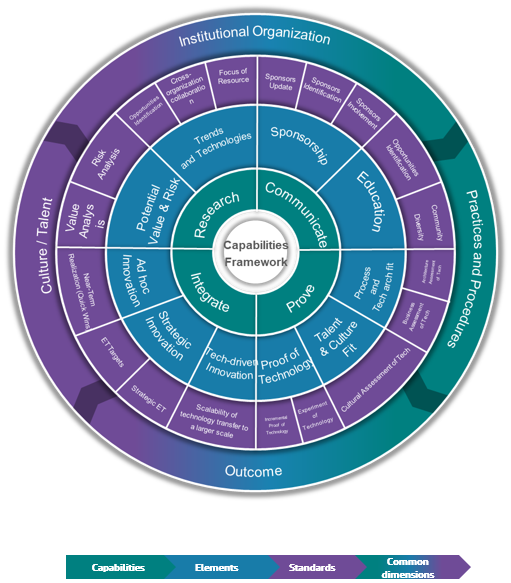
The above figure shows the framework that was developed and designed to assess the readiness of government entities to adopt emerging technologies. This framework consists of four key capabilities (research, communication, prove, and integration), from which ten elements branch from which nineteen standards also branch, with four intersecting dimensions that fall within each standard.
2.4 The four key capabilities that are assessed Within the framework of the Emerging Technologies Adoption Readiness Index
- Research: Due to the rapid rate of change, it is essential to allocate resources to the wide monitoring of several forms of trends, such as those involving beneficiaries, competitors, markets, or technologies, as well as the information technology that allows each of these types of trends. In addition, it is crucial that researchers work together across their organizations and with partners to capture these patterns, identify possibilities for each developing technology, and then allocate each opportunity to either the short or long term.
- Communicate: Emerging Technology research cannot survive for long without clear and consistent lines of communication, such as slide shows or reports, in which targets and results of technology trend analysis are presented in a simplified manner to the recipient. It is necessary to direct the appropriate information toward the appropriate audience on the one hand and to differentiate the process of providing general education in order to engage stakeholders from the practice of providing particular communication in order to pursue investment on the other hand.
- Prove: In order to express an opportunity in a way that is persuasive to others, it needs the knowledge and expertise that can only be obtained via actual hands-on experiments. With the aid of the “prove capability,” the agency will not only be able to determine whether the technology is ready to meet the requirements but also whether the agency is ready for the technology.
- Integrate: Innovations that are strategic in nature are those that pursue medium/long-term emerging technology opportunities that align with the agency's broad objectives. This capability assesses how well the agency is equipped to operationalize emerging technologies on large scales in a way that supports the strategic objectives while also being economical and practical in its implementation.
3. Evaluation mechanism
Emerging technologies adoption readiness was assessed according to the following three stages:
First Stage: Current State Assessment
This stage involves assessing the current state of participating agency's and defining the agency's Readiness to Adopt Emerging Technologies. This assessment is based on the data and evidence provided by the covered entities during the evaluation sessions that were held.
Second Stage: Readiness Level Determination
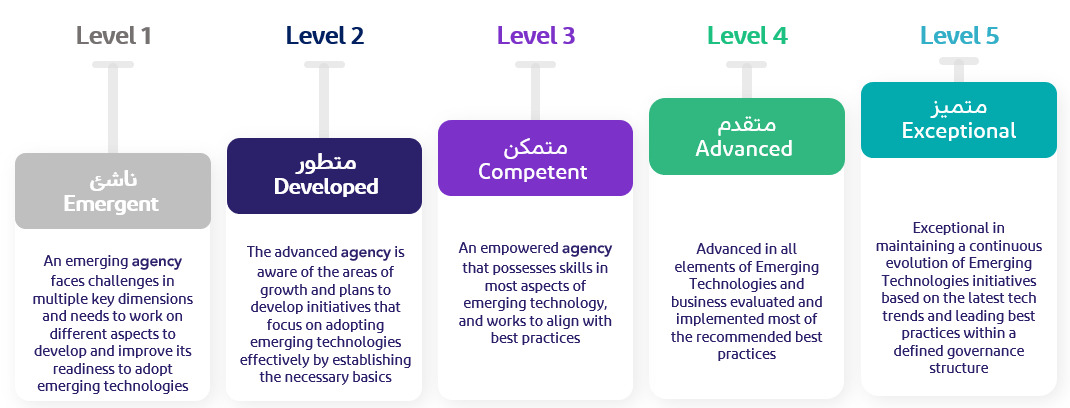
At this stage, readiness levels were determined by analyzing the data collected during the first stage, processing the inputs, and calculating points within each of the four capabilities, where the level of readiness progress in each agency was determined based on the result of assessing its current situation, and applying the readiness determination equation. Which shows the agency’s capabilities within the five levels of readiness.
Third Stage: Recommendation and Action Plans
At this stage, recommendations and action plans for improvement were presented, which include suggestions and recommendations on specific action elements that fall within each of the dimensions analyzed, in order to support the agency in progressing through the five levels. In addition, the agency can view the emerging technologies adoption guidelines and understand the various factors necessary to organize efforts and achieve the desired results, while reducing the risks surrounding the journey of adopting emerging technologies.
4. Classification of emerging technologies adoption readiness level
The level of government entities readiness is determined according to the result of emerging technologies adoption readiness index, according to the capabilities and their sub-criteria in each measurement cycle within one of the following five levels:
For more information: Check the digital version.
Suggestions and comments
For any inquiries or comments about the services or the current page, please fill in the required information.
Add Comment