


 Night Mode
 Maximize
 Minimize


All links to official websites of government agencies in the Kingdom of Saudi Arabia end with .gov.sa

Secure websites in the Kingdom of Saudi Arabia use the HTTPS protocol for encryption.



 Published 10/03/2024
 Published 10/03/2024
Night Mode
Maximize
Minimize
Published 10/03/2024
Night Mode
Maximize
Minimize
 General
 DGA-1-2
 2.0
2.0
This document includes all the policies issued by DGA, which are included in the Digital Government regulatory framework, which is a regulatory tool, whereby the design and development of regulatory documents are strategically governed and implemented in accordance with eight main principles.

 Once-Only Principle
 Digital-first
 Mobile-first
 Digital by default
 Government as a Platform
 Digital by design
 Open by default
 Ease of policy Formulation
Based on Cabinet Decision No. 418 of 25/07/1442 AH approving regulations of the Digital Government Authority (DGA), which stipulates that DGA is the competent authority for all issues relating to Digital Government and that it is the national reference in its affairs, and based on DGA’s competence to organize the work of the Digital Government and to ensure integration between all government agencies, and according to its competence and functions under Article 4 of the above-mentioned cabinet decision mandating the DGA to organize the Digital Government work, including by issuing regulation related to the DGA’s activity, setting plans, programs and indicators, regulating operations, processes and related projects, and following up on compliance
As such, DGA prepared and issued the "Digital Government Policy" on 29 September 2021 and prepared and issued the five policies derived therefrom which are consecutively as follows: "Governance and Compliance Policy", “Whole of Government Platforms Policy", "Digital Services Lifecycle Administration and Upskilling Policy", "Beneficiary Centricity Policy" and "Technology Policy“, all of which have been integrated into this document under one title “Digital Government Policies”. Their close interdependence and shared objectives are aimed at improving the regulatory environment of the Digital Government, accelerating and enabling Saudi Arabia’s sustainable digital transformation
This document includes all the policies issued by DGA, which are included in the Digital Government regulatory framework (Figure. 1), which is a regulatory tool, whereby the design and development of regulatory documents are strategically governed and implemented in accordance with eight main principles.

Digital Government Policies outline the Digital Government directions, empower and accelerate the sustainable digital transformation of the government sector in the medium and long term, help government entities develop strategic plans aligned with the Digital Government's strategic directions, and enable the successful implementation of those designed plans, based on a set of focus areas within four main pillars (Figure 2), each of which covers a number of provisions in a coherent and integrated manner, as follows:
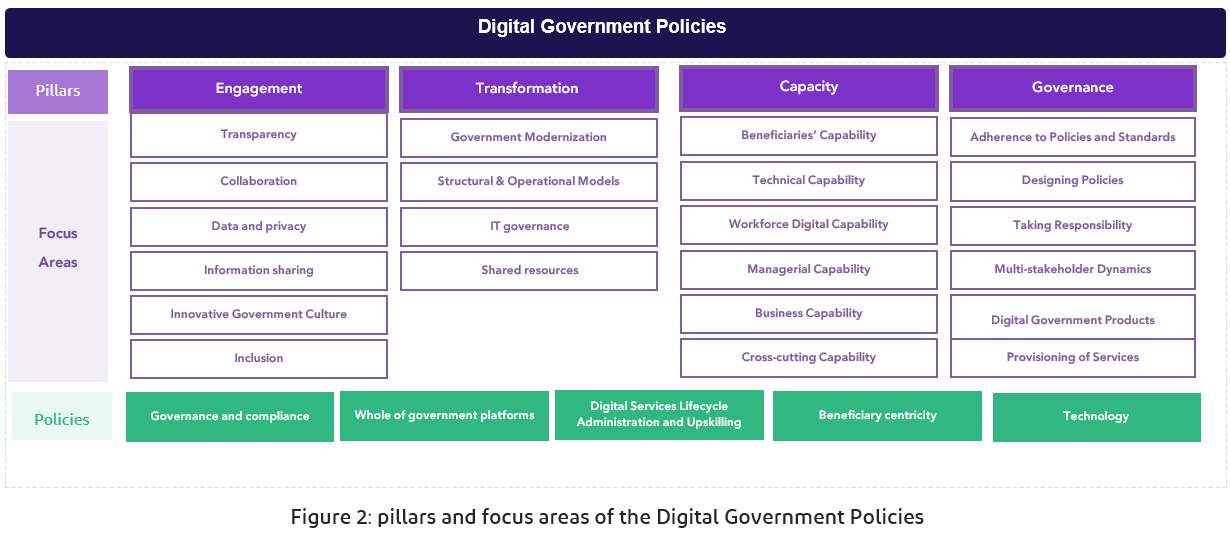
These policies cover the pillars of Digital Government, including the governance of related fields, as well as the most important aspects related to government digital platforms, service management, digital skills development, and improved beneficiary experience, as well as aspects related to the fundamental pillars of technology along with the technologies supporting the government digital business, cloud computing, data management, and innovation.
Applying the Digital Government Policies for:
Engagement requires the participation of and collaboration with institutions from government, the private sector, civil society and beneficiaries so they can provide valuable inputs for digital government implementation:
1- Transparency: Government entities shall foster increased participation, which fosters public trust in government, and active citizen involvement ranging from basic consultation and information sharing to joint development and co-creation. Government entities shall also use digital technologies and innovation to support effective communication among participants.
2- Collaboration: Government entities shall work collaboratively with all groups active in the digital government ecosystem – namely, government, the private sector, and civil society organizations. The broad collaboration will help identify gaps and priorities in the provision of services and information thus propelling a more efficient allocation of resources – people, funding, and technology. Current gaps between supply (government) and demand (beneficiaries and other targeted institutions) will be minimized, resulting in increased beneficiary satisfaction with government services.
3- Data and privacy: Government entities shall align regulations related to data management, security, and privacy with existing legislation issued by the relevant government entities. Government entities shall also encourage beneficiaries’ participation to share data comprehensively while ensuring beneficiaries’ data protection and facilitating easy access to personal data.
4- Information sharing: Government entities shall make available data that is classified as public information in accordance with existing regulations issued by relevant government entities. As a result, beneficiaries will be fully informed when accessing government services that offer engagement and participation mechanisms. Government entities shall also comply with policies and regulations protecting confidential information as per existing regulations issued by other relevant government entities.
5- Innovative Government Culture: Government entities shall create a culture of information, data sharing, and collaboration, and promote interaction across institutions from different sectors – government, the private sector ,and civil society - to foster a more effective digital government and contribute to the Kingdom’s Vision 2030 goals.
6- Inclusion: Government entities shall adopt an inclusive approach to ensure information access by people with disabilities and from vulnerable communities so that they can engage with the government effectively.
Transformation includes the enablers that drive the development of government – the main emphasis being on modernization, not technology. Transformation demands an integrated approach to institutional modernization – changes to managerial, organizational, technical, and business processes – that will drive high-quality digital government platforms and services.
1- Government Modernization: Government entities shall link their digital transformation and use of new technologies to broader government modernization processes in order to build enhanced capabilities and increase the availability and quality of both digital services and whole-of-government platforms.
2- Structural & Operational Models: Government shall take a comprehensive approach to transformation, not limited to technology. Government entities will align their existing business model to the priorities of the National Digital Government Strategy while updating required management skills, internal structures, and administration processes.
3- IT governance: Government entities shall strengthen internal governance of information technology in accordance with related standards while ensuring alignment with policies and standards issued by DGA, the latter already aligned with international bodies such as ISO.
4- Shared resources: Government entities shall give priority to shared resources and capabilities available on whole-of-government platforms. Government entities shall also identify and address the current challenges and gaps in skilled resources by engaging with relevant government entities.
The pillars of engagement and transformation require access to an e-client digital government ecosystem, including the local private sector, that facilitates the much-needed change in government entities. Change and process management overall Capability, as well as technical expertise, is needed to strengthen an enabled government workforce and drive complex transformation processes.
1- Beneficiaries’ Capability: Government entities shall increase beneficiaries’ (government entities) awareness and promote digital skills by conducting awareness workshops that will digitally empower beneficiaries to interact effectively and efficiently with the government, actively use participation platforms, and be part of decision-making processes.
2- Technical Capability: Government entities shall strengthen their technical capabilities to support the National Digital Government Strategy implementation, including understanding the impact of new technologies on government operations to adopt and encourage their use. Government entities shall build a capable and empowered technical workforce to ensure the successful adoption of digital transformation.
3- Workforce Digital Capability: Government entities shall develop the digital capabilities of all employees so that the entire workforce contributes to the transformation of the workplace needed for digital government. Government entities shall develop and adopt initiatives that aim at closing current digital skills gaps and thus meet labor market demand.
4- Managerial Capability: Government entities shall enhance administrative and managerial capabilities to achieve an effective return on digital investments. Digital Government projects require high-quality project management for successful implementation.
5- Business Capability: Government entities shall enhance the business capabilities of staff through feasibility studies and business case development for digital initiatives, following regional and global best practices and experience.
6- Cross-cutting Capability: Government entities shall increase the efficiency and effectiveness of working across government and strengthen the capabilities required to respond collectively, especially in crisis times
Governance contributes to the realization of all the principles mentioned above through, (1) overseeing and monitoring the adoption of the Digital Government Policy by DGA and other relevant government entities, as well as compliance with standards and procedures published by DGA; (2) encouraging collaboration across the digital government ecosystem; (3) ensuring continuous engagement and communication between government entities driving digital transformation; (4) ensuring policy coherence across government entities, and (5) justifying the costs of government digital services within the government sector.
1- Adherence to Policies and Standards: Government entities shall comply with policies and standards issued by DGA, the technical standards on digital transformation models, and digital government regulations issued by other government entities. DGA will monitor and report compliance, as will provide advisory services to raise the level of compliance across government.
2- Designing Policies: Government entities shall work closely with DGA in the development of digital government policies, regulations, and principles. The DGA will also support gap identification and their closing.
3- Taking Responsibility: Government entities shall be responsible for the proper and effective implementation of digital government, including full compliance with policies and standards by any of the service providers contracted to furnish digital government services.
4- Multi-stakeholder Dynamics: Government entities shall engage external parties such as businesses, civil society, and citizens in executing the initiatives and overall strategic direction of the National Digital Government Strategy.
5- Digital Government Products: Government entities shall adhere to the standards envisaged for digital government products and work directly with DGA to oversee their implementation in cooperation with the relevant authorities.
6- Provisioning of Services: Government entities’ service providers (developers and service operators) shall adhere with the Framework and all relevant decisions issued by DGA.
Governance of all areas related to digital government conducted by government agencies, and the extent of their compliance with regulations related to digital government. The policy covers the following areas:
Overseeing the work of the digital government in terms of setting the necessary policies and standards, measuring performance, the maturity of digital government services, and the extent of compliance with the regulations issued by the authority, through:
It includes protecting and confidentiality of the data of individual beneficiaries and preserving their rights, and government entities must work to achieve this through:
It includes everything related to the return on investment for digital government business by government agencies, through:
It includes everything related to the issuance of licenses and accreditations by government agencies to developers and operators of digital government business from the private sector, and achieving this through:
It includes everything related to the supply of products related to the business of the digital government, including services, solutions, systems, etc., provided by the private sector to government agencies, and this is achieved through:
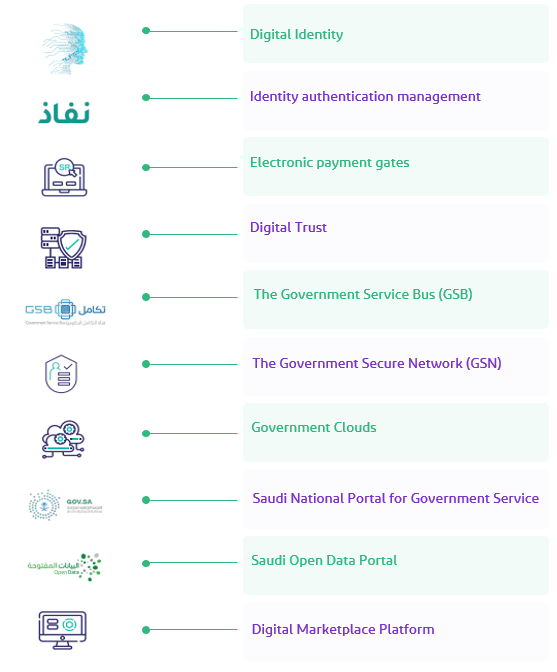
This policy covers key aspects related to Whole of Government Platforms and its key enablers, which includes, but not limited to, the following:
The policy covers the different aspects related to managing and administrating government digital services provided to beneficiaries through the different digital channels, in addition to the aspects related to digital skills development.
Compliance with this policy by government entities ensures the provision of efficient government digital services that fulfill beneficiaries' needs and meet their expectations as it sets the directions and general provisions for:
Includes all aspects related to government digital service design at all stages, for the service to be clear, simple, consistent, flexible, and proactive, as much as possible, in accordance with the regulations issued by the Digital Government Authority and the relevant government agencies. Government entities should work to achieve this by:
Includes all aspects related to providing the content of government digital services and its related data and making it available to beneficiaries anytime and anywhere through the different digital channels, in accordance with the regulations issued by the Digital Government Authority and the relevant government agencies. Government entities should work to achieve this by:
Includes all aspects related to providing government digital services through mobile phones and smart devices, in accordance with the regulations issued by the Digital Government Authority and the relevant government agencies. Government entities should work to achieve this by:
Includes all aspects related to developing the digital skills, qualifications, and managing the talents in the local workforce, in accordance with the regulations issued by the Digital Government Authority and the relevant government agencies. Government entities should work to achieve this by:
Includes all aspects related to identification of top priority digital services, in accordance with the regulations issued by the Digital Government Authority and the relevant government agencies. Government entities should work to achieve this by:
This policy covers all aspects related to improving the beneficiary's experience of digital government services and enhancing participation and communication between government agencies as service providers and beneficiaries.
Compliance with this policy by government entities will guarantee focus on the beneficiaries needs and understanding of their needs, requirements and aspirations when designing digital government services, by setting general principles and provisions for the below areas (Detailed in Figure 2):
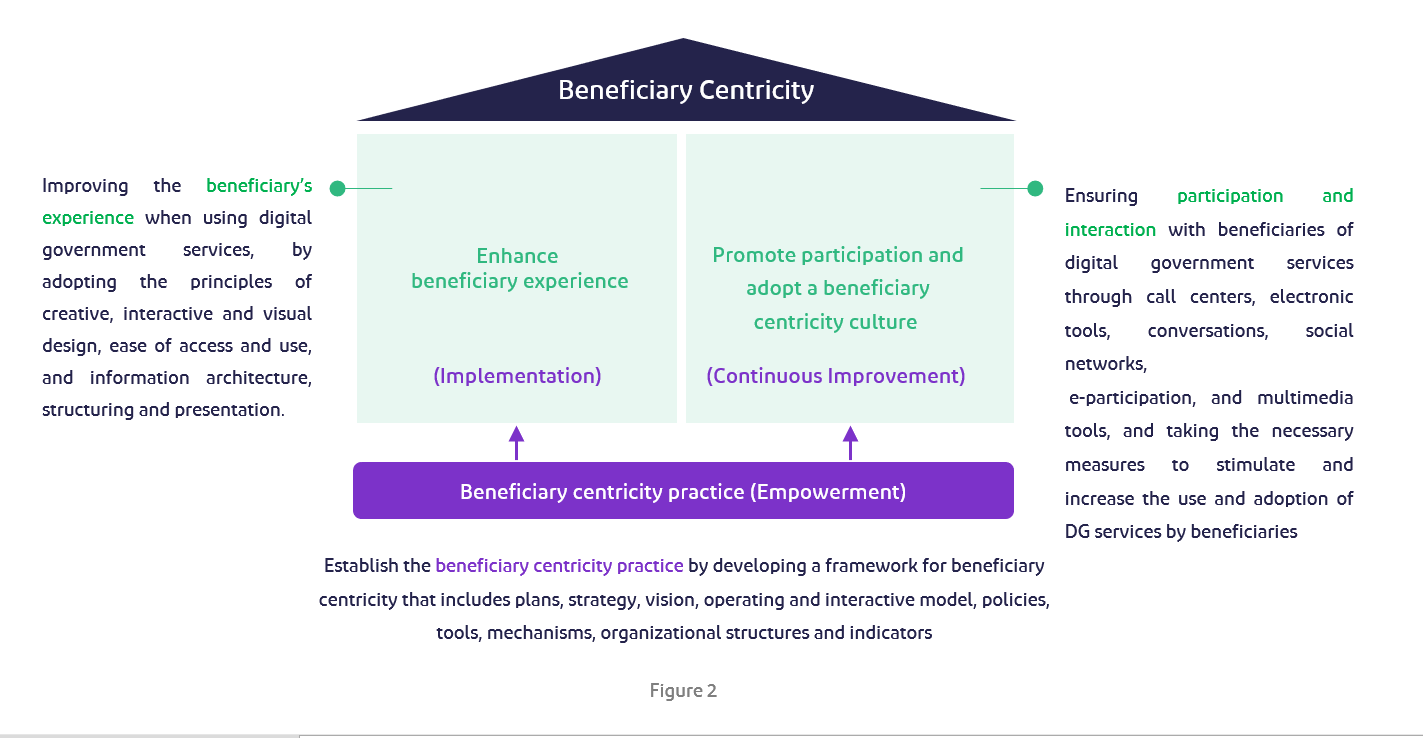
Includes all aspects related to establishing the beneficiary centricity practice to ensure maximum benefit from the government digital services, and their adoption by the beneficiaries, in accordance with the regulations issued by the Digital Government Authority and the relevant government agencies. Government entities should work to achieve this by:
Includes all aspects related to improving the beneficiary experience when interacting with the government entity through digital channels and using the government digital services available on these channels, in accordance with the regulations issued by the Digital Government Authority and the relevant government agencies. Government entities should work to achieve this by:
Includes all aspects related to promoting the participation of beneficiaries, and enhancing communication with them, and following up on the adoption rates of the digital government services, in accordance with the regulations issued by the Digital Government Authority and the relevant government agencies. Government entities should work to achieve this by:
This policy covers aspects related to the main technology pillars supporting the Digital Government activities including the Government Digital Services and internal operations, Cloud Computing, Data Management, and Innovation.
The Technology policy identify the main technology pillars that government entities should use to support the delivery of digital government services, operations, data management, and innovation in the field of emerging technologies as it sets the directions and general provisions for:
Includes aspects related to encouraging government entities to adopt and promote innovation in delivering technology solutions to operate the digital government activities, in alignment with regulations issued by the DGA and the relevant government entities. Government entities should aim to achieve that through:
Includes aspects related to designing the technical infrastructure related digital government activities to achieve a better quality of government digital services, enhance beneficiaries' experience, and achieve the optimal utilization of available resources, in accordance with regulations issued by the DGA and the relevant government entities. Government entities should aim to achieve that through:
Includes aspects related to making IT investments into co-location infrastructure, cloud hosting, and cloud software to increase economies of scale, increase productivity, increase Digital Government Services agility, scalability and stability, in accordance with regulations issued by the DGA and the relevant government entities Government entities should aim to achieve that through:
Include aspects related to developing and investing in emerging technologies as part of the technologies related to government activities to provide enhanced digital services to beneficiaries and achieve optimal use of the available resources, in accordance with regulations issued by the DGA and the relevant government entities. Government entities should aim to achieve that through:
It includes all aspects related to the management and governance of data that arise from and benefit from technologies that support digital government in accordance with the regulations issued by the Authority and adherence to the national data governance policies issued by the National Data Management Office. Government entities must work to achieve this through:
Includes aspects related to ensuring the continuity and availability of technologies related to digital government activities and its ability to adapt, in accordance with regulations issued by the DGA and the relevant government entities. Government entities should aim to achieve that through:
| Term | Definition |
|---|---|
| Authority | Digital Government Authority |
| Digital Government | Promotes administrative, organizational and operational processes between the various government entities in their transitioning to a comprehensive digital transformation to allow easy and effective access to government digital information and services. |
| Government Entity | Ministries, authorities, public institutions, councils, national centers including any additional form of a public entity. |
| Beneficiary | Citizens, residents, visitors, government agencies, private sector, non-for-profit sector, inside or outside the KSA that require to interact with a government entity to receive any of the services offered in the Kingdom. |
| Digital Transformation | Digitally and strategically transforming and developing business standards and models that would rely on data, technologies, and ICT. |
| Electronic Transactions | Any exchange, communication, contracting or other procedure performed or executed, wholly or partially, by electronic means |
| Policy | A Policy defines the course or principles of action to guide and determine present and future actions and it specifies what government entities are required to do. Policies can have related standards that provide more information for entities. |
| Standards | A set of rules and controls regulating the operations and tasks related to the digital government. |
| Guidelines | Provides examples showing the implementation mechanism of the of policies and standards in place. |
| Pillars | Four elements that are the foundations of the DGP. |
| principles | Basic and integrated pathways for determining key regulations of government entities relating to the digital government |
| Beneficiary | Citizens, residents, visitors, government agencies, private sector, non-for-profit sector, inside or outside the KSA that require to interact with a government entity to receive any of the services offered in the Kingdom. |
| Digital Marketplace Platform | A platform that enables government entities to purchase and acquire services and technical assets (such as: software, hardware, communications services, managed services, cloud services(, and complete purchases, payment and receipt through the electronic portal for government competitions and procurement. |
| Participants | Beneficiaries, the private sector or civil society. |
| Stakeholder | Parties and entities that affect and are affected by decisions, directions, procedures, objectives, policies and initiatives of the digital government and share some of their interests and outputs and are affected by any change that occurs in them. |
| Governance structures | Guides and tools through which to ensure that the decisions and procedures of any party, whether administrative or financial, are carried out through a specific and accurate system or procedure, and its also group of necessary operation to guide and control the entities and define the principles between all stakeholders in the government entities . Decisions on implementing digital initiatives. |
| Civil Society | Non-for-profit entities engaged in social services achieving public interest, such as charities and foundations such as Misk Foundation. |
| Digital Product | Digital solutions serving the same scope and offered as one group through digital channels such as electronic portals and smart device applications, and these solutions enable the beneficiary to complete a request or a service. Products may include software, information, or a related set of services that are associated with providing a specific outputs to beneficiaries, such as: Passports, Traffic and Civil Affairs. |
| Services Provisioning | Any interaction between the beneficiary and the government authority in relation to the provisioning of services. |
| Whole of Government Platform | A Whole of Government Platform is a technology-enabled, business-driven central platform to continually manage, improve, and deliver government services across multiple digital touch points. It provides unified, seamless, integrated cross-channel consistency, omni-channel user insights, and active user engagement at every digital touchpoint. |
| Saudi national Portal for Government Services (GOV.SA) | The Unified National Platform that is used to provide digital government services |
| Digital Identity | Data – in its digital form - that characterizes the identity of a person. |
| Identity Authentication Management (NAFADH) | Data – in its diUnified national information services and systems aiming to enable the verification of digital identities and their characteristics for beneficiaries of digital services and platforms.gital form - that characterizes the identity of a person. |
| Digital Trust | A government service used to verify that the electronic transaction is reliable and trusted. |
| The Government Service Bus (GSB) | A unified platform used for Government shared services that are continuously updated and provides integration between government entities quickly and securely. |
| Government Secure Network (GSN) | A communication network designed for e-government transactions. This network connects government entities to a unified data center. |
| G-Cloud | This is a Cloud typically fully owned by a Government and provisioned for the exclusive use of Governmental authorities. Operations for this Cloud could be done by a Governmental authority, a third party (e.g. a Cloud Service Provider) or a combination of these. It is typically located inside the country, mainly to protect data sovereignty |
| National Open Data Portal (data.gov.sa) | The National Open Data Portal is a public database that enables transparency, encourages community participation, and inspires innovation by publishing data sets of government entities in the form of open data, making this data available to all beneficiaries. |
| Proactive Notifications | Notifications that are predicted or expected based on beneficiary needs, preferences and life events and based on data, information and documents known to the government and proposing them in a timely manner, before the beneficiary requests them. |
| Metadata | Information that describes data and its characteristics, including business data, and technical and operational data. |
| Digital Service Lifecycle | Includes all stages that the digital service goes through, such as: discovering beneficiary requirements and current challenges, defining digital services, designing service delivery procedures and channels, releasing it to beneficiaries, managing it and measuring its performance. |
| World Wide Web Consortium (W3C) | The World Wide Web Consortium (W3C) is an international community that develops open standards to ensure the long-term growth of the Web. |
| Omni-Channels | Multichannel approach to provide seamless, consistent experience for beneficiaries through different digital channels throughout service delivery, whether the beneficiary requests the service from the a website, a mobile phone or a smart device. Omni-channel approach is different than the Multichannel approach by providing the user with the ability to work on the service using different channels without discontinuity. |
| Beneficiary Experience | Beneficiary’s perceptions and related feelings caused by the one-off and cumulative effect of interactions with the government entity’s employees, systems, channels, or services. |
| Digital Channel | A digital means of communication to display information or offer digital services and products to beneficiaries, such as websites, digital portals, smart device applications, e-mail, self-service kiosks, call center services, social networking sites and applications or Chabot's. The services may be provided on all channels or selectively on some of these channels. |
| Digital Service | A group of digital procedures linked to each other to perform a full function offered by the government agency to the beneficiary through digital channels such as electronic portals and smart device applications, and it provides one main and specific deliverable. A group of related services will form a product, such as: Issue Passport, Renew Driving License, Query Traffic Violations, National ID Renewal. |
| Top Priority Services | The digital services that have been identified by the Digital Government Authority or the United Nations. |
| Digital Content | The tool is entrusted with achieving the purpose of creating websites, platforms, applications, and various other digital channels and achieving strategic goals towards the beneficiaries of those sites and platforms. The digital content of websites includes various forms, for example, written content, audio and video clips, images, shapes, charts, etc. |
| Required content for the services | The basic attributes to be defined for a service such as: the purpose of the service, prerequisites, steps to complete the service, service fees, target audience, service channels, service response time, service level agreement (SLA), customer support details, and related services. |
| E-government Development Index (EGDI) | The EGDI monitors and measures progress of world governments in digital transformation. The EGDI is composed of three sub-indices: online services index (OSI), telecommunication infrastructure index (TII) and human capital index (HCI). |
| Digital Skills | Set of skills that equip the workforce with the ability to interact with information technology and digital solutions and helps them innovate to develop internal operations and services. |
| Beneficiary Centricity | The ability of government entities to understand beneficiaries' situations, perceptions, and expectations. It requires having beneficiaries as focal points of all decisions related to delivering government services and experiences. |
| Promote Beneficiary participation | Involvement of beneficiaries in digital government service design through obtaining their insights and ideas on service delivery to help government entities understand their experiences. |
| Adopt beneficiary centricity culture | Developing and implementing strategies, methodologies and mechanisms within the government entity to support their employees in adopting a beneficiary centricity culture and measuring their performance through it. |
| Accessibility | Ensure easy access to services by all beneficiary segments, including inclusiveness, equality and accessibility guidelines (W3C). |
| Usability | Quality of user experience when interacting with products and systems, including websites, software, devices, and applications. They are also linked to effectiveness, efficiency, general user satisfaction, and easily usable product or system. |
| Balance | Use of design elements to achieve visual balance in presenting content for beneficiaries including the color, size, position, shape, and repetition. |
| Emphasis | Use of design elements to highlight a difference in presenting content for beneficiaries. |
| Hierarchy | Use of design elements to ease navigating through content through the way it is presented. |
| Equal access | Necessary arrangements to ensure accessibility to all beneficiary segments to the digital government services. |
| Accessibility to information and government digital services | Adopt technical standards and use of technology solutions to ease target beneficiaries access to information and government digital services |
| Electronic participation | Digital interaction and participation that allows the beneficiaries to provide their feedback, share their ideas and suggestions about specific topic related to society, this includes conducting voice of customer studies, to improve government services that revolves around the beneficiary needs |
| Beneficiary Expectation | Set of ideas that the beneficiary has about government digital services |
| Beneficiary Behavior | Actions and steps taken by the beneficiary when obtaining the government digital services, it includes all feelings and the way they react to the service |
| Analysis of beneficiary experience | Identify pain points and improvement opportunities at all stages of the beneficiary journey while interacting with the government entity |
| information architecture | Visual representation used to represent content and data elements in different levels of details and its interrelationship |
| Creative Design | It is a type of design that uses digital solutions to illustrate a future service or product |
| Interactive Design | It is a type of design that uses collaborative and interactive communication with the end users and involve them in designing future services and products |
| Visual Design | It is a type of design that uses visuals and illustrative designs to represent an idea or a concept |
| Innovation | An innovation is the implementation of a new or significantly improved product (good or service), or process, a new marketing method, or a new organisational method in business practices, workplace organisation or external relations. |
| Cloud Computing | A model which enables convenient, on-demand network access to a shared pool of configurable computing resources (e.g. networks, servers, storage, applications, and services) that can be rapidly provisioned and released with minimal management effort or service provider interaction. |
| Cloud services | Provide ICT services through cloud, this includes storing, migrating or processing subscriber’s data in the cloud computing system. |
| Community Cloud | Cloud computing system provided for the exclusive use of a closed group of subscribers who share some social, business, administrative or other goals. |
| Public Cloud | Any cloud computing system available for open use by an entity or an individual. |
| On-Premises | On-Premises means hardware and software that is deployed to a Data Center that is exclusively used by a single Governmental Entity or a Private Cloud. |
| Off-Premises | Off-Premises means hardware and software that is deployed to a Data Center that is used by a community of Governmental Entities and/or a Data Center that is open for use by the general public. |
| Minimum Viable Product | It is an initial version of the final product which has the minimum properties to test the product with users. |
| Proof of Concept | The process of testing an idea under development on a small scale to demonstrate its feasibility, impact, and the transition to the initial product stage. |
| Safe testing environment | A testing environment that supports government entities designing innovative solutions to offer their digital services safely and flexibly; in order to guide decision making and implementation directions. |
| Main technology pillars | Elements of the technologies related to digital government activities, which include Innovation, Core Technologies, Cloud Computing, Emerging Technologies, Data Management and Governance, and Operations and Resilience. |
| Legacy Technologies | An information system that may be based on outdated technologies but is critical to day-to-day operations. |
| Operations | Group of interconnected or interacted activities that are executed through the technologies related to digital government activities. |
| Open-source Software | The software whose source code is freely available to anyone to access, modify, use and distribute |
| Artificial Intelligence | It is a branch of computer science concerned with building smart machines capable of understanding their environment and performing tasks that require a certain level of intelligence. |
| Internet of Things | A network of electronic devices, software and sensors that allow machines to interact with each others. |
| Open Standards | The standards that are accessible and usable by others, while keeping the ownership to the developing entity and they have the authority to issue terms of use and user rights. |
| Blockchain | is a shared, immutable ledger that facilitates the process of recording transactions and tracking assets in a business network. |
| Robotic Process Automation | A type of process automation in which software or robot mimics how humans accomplish a task. |
| Augmented Reality | Additional information or visual images superimposed on the physical world, often through computer-generated graphics and/or sound overlays, to improve the user experience of a task or product. |
| Data Modelling | The process of building a conceptual representation of data and their relationships to be stored in a database. |
| Availability | The system ability to ensure access to information, data, systems, application compared to downtime. |
| Response Rate | Measures the system ability to return results. |
| Compatibility | Measures the system ability to operate with different hardware, operating systems, and browsers. |
| Scalability | The system ability to adapt with changing requirements. |
| Capacity | The system operating capacity at any point of time. |
| Cloud Software | Software operating in a cloud-based environment. |
| Co-location | Any Data Center facility that rents out rack space to third parties for their servers or other network equipment. |
| Rehosting Technique | Strategy, commonly known as lift-and-shift, is a widely chosen strategy due to the relatively low migration effort and the migration speed. |
| Rebuilding Technique | Strategy that usually leads to the highest transformation cost. However, it allows optimized use of the cloud, leading to cloud-native benefits and making the application future proof. |
| Revising Technique | Strategy that leads to cloud optimization due to some cloud platform adoption, while keeping the application core architecture the same. |
| Replacement Technique | Strategy that discards legacy application and develop again using cloud services and features. |
| abbreviation | Definition |
|---|---|
| W3C | World Wide Web Consortium (W3C). |
| WCAG | Web Content Accessibility Guidelines (WCAG). |
| CMMI | Capability Maturity Model Integration. |
| ITSM | Information Technology Service Management. |
220 Visitors Said Yes from 227
Suggestions and comments
For any inquiries or comments about the services or the current page, please fill in the required information.
Add Comment