





 Published 22/01/2025
First Title
Organizational Structure
Organizational Structure's picture
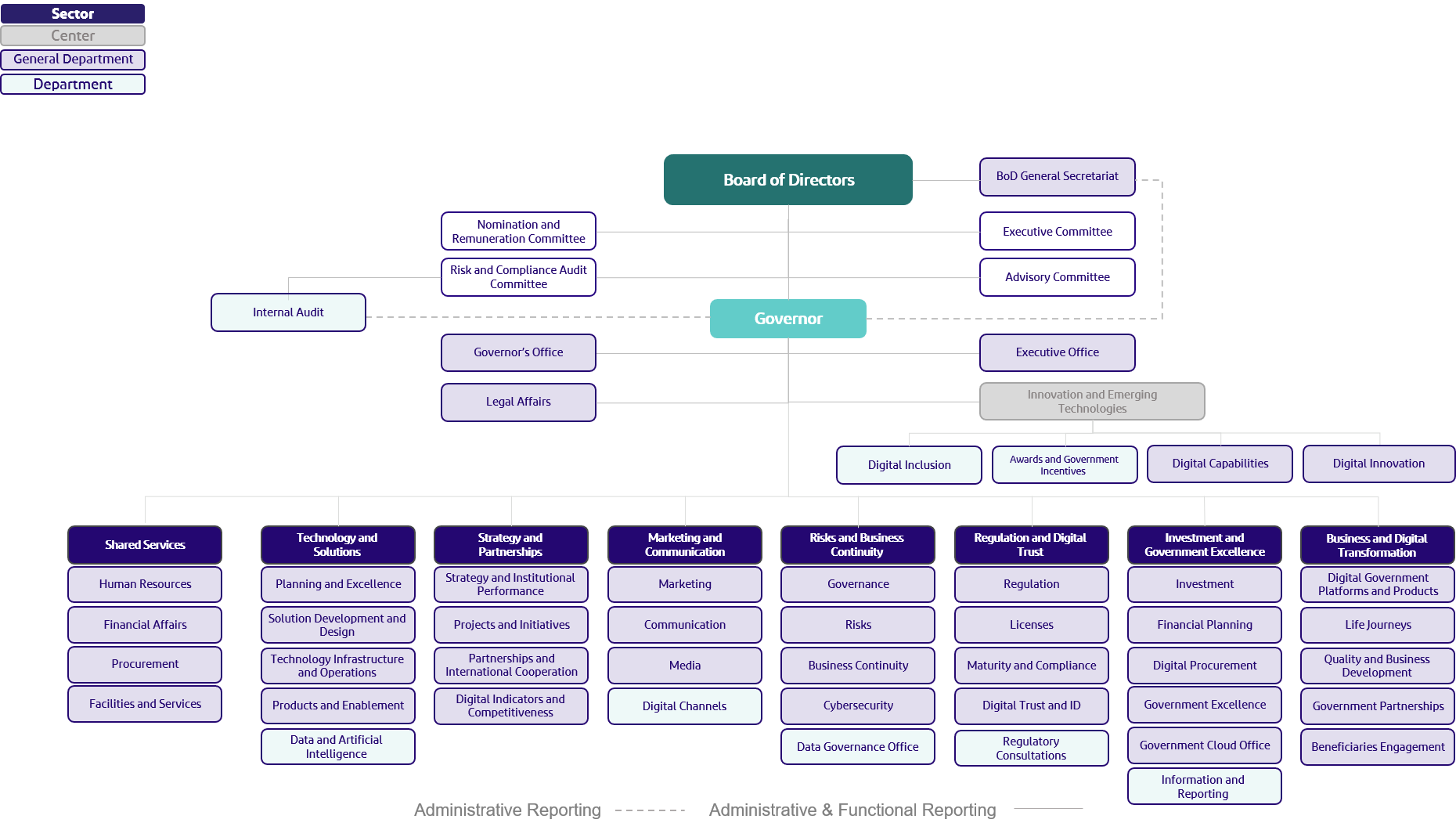
Authority's Sectors
First Title
The Digital Regulation and Trust Sector
About Sector
The Regulation and Digital Trust Sector is responsible for studying market needs, analyzing regulations, proposing legislative projects, and updating relevant laws. It also develops strategies for digital trust and identity, reviews international frameworks, and strengthens cooperation with external partners. The sector oversees government cloud governance, develops regulatory frameworks for licensing, monitors compliance, and measures the digital maturity of government entities.
Tasks Sector
- Study market needs for regulatory initiatives, analyze existing and potential regulations, assess their impacts, and define expected outcomes.
- Propose legislative projects and update relevant laws, regulations, and policies.
- Engage with stakeholders to collect feedback on proposed regulations, policies, and standards to enhance their effectiveness and alignment with needs.
- Analyze and evaluate the impact of implemented regulations, policies, and standards.
- Assess requirements for digital trust and identity, develop emerging technology strategies in this domain, promote adoption of related services, and provide advisory support.
- Review international digital trust and identity regulations, align with them, and issue related policies, procedures, and guidelines.
- Enhance cooperation with countries and external partners for mutual recognition of trust lists, joint research, and building national capabilities in digital trust and identity services.
- Govern national digital government cloud operations.
- Develop regulatory frameworks for licensing and registration systems, and oversee issuance and renewal of licenses.
- Classify and register suppliers and operators, and manage license issuance and renewal.
- Monitor licensed companies and suppliers, ensure compliance, review service performance, address violations, and oversee corrective actions.
- Measure the digital maturity level of government entities and prepare related reports.
- Support the development and follow-up of corrective action plans.
Objectives Sector
- Unifying the concept of regulations, including policies, controls, and standards, and reflecting the organizational characteristic thereon.
- Enhancing digital performance and promoting the quality of governmental services provided.
- Improving the regulatory environment for practicing business in the field of digital government.
- Contributing to promoting and improving Saudi Arabia's order or rank in the relevant international indicators.
- Raising the levels of commitment by governmental authorities' to orders, decisions, and circulars issued regarding digital transformation and digital government.
- Following the international practices for establishing or providing organized, reliable, and safe services for achieving the optimum benefit for the system parties.
- Governance and development of digital identity and trust system at the national level for supporting adoption of digital identity and trust services in both public and private sectors.
- Effective regulation of pricing to ensure that digital identity and trust services are widely adopted in both public and private sectors.
Sector contact information
Please call 199099 or email: [email protected]
First Title
The Risk and Business Continuity Sector
About Sector
The risk and Business Continuity Sector is one of the sectors of Digital Government Authority. It comprises five departments: (The risks Department, Business Continuity Department, Governance Department, Cyber Security Department, and Data Governance Office). These departments are competent in planning, implementing, and supervising Business Continuity, Governance Management, as well as Risks Management for the Authority works, besides the work of digital government, through developing effective plans, standards, and controls in order to be ready for incidents, as well as providing consultations to support both fields: risks and business continuity.
In addition to governance, the sector contributes to the performance of the Authority work by issuing general policies and legislation, and work is locally executed, as well as establishing the matrix of roles, responsibilities, and powers. The sector is endeavoring to establish and operate a data governance office concerned with developing and activating the framework of data governance, besides providing consultations to enable compliance with the policies of the national data governance issued by the Saudi Data and Artificial Intelligence Authority (SDAIA). The sector is also seeking to identify and monitor cyber threats and risks that the Authority may encounter, as well as define the procedures that must be taken to prevent these threats and to handle it efficiently if it occur.
Tasks Sector
Providing support and consultation to governmental authorities and promoting maturity in governance, risks, and business continuity.
Holding awareness workshops inside and outside the Authority, besides promoting awareness in the field of governance, risks, business continuity, and cyber security.
Establishing and developing digital government standards, guidelines, and controls in governance, risks, and business continuity.
Providing support for the continuity of digital government services and follow-up through receiving reports of the services' disconnections.
Determining and reporting security risks and determining how it affects the confidentiality and safety of information assets.
Providing response services for managing or handling any threats or incidents affecting cyber security and affecting Digital Government Authority.
Developing mechanisms for responding to incidents related to cyber security in the Authority and following up the commitment to that, and
Determining and evaluating the organizational risks according to the framework of organizational risk management.
Developing Business Continuity Program of Digital Government Authority.
Objectives Sector
Promoting digital government maturity in governance, risks, and business continuity.
Building and developing the governance, risk, and business continuity framework according to best international practices and activating and applying the Authority defense lines.
Ensuring that the governmental authorities commit to the legislations, controls, and standards the Digital Government Authority issued.
Ensuring the development and documentation of policies and procedures under the sector's control.
Ensuring that the Authority commits to all local laws and regulations and provides consultations.
Developing cyber security strategies and policies, managing security risks, along with periodical reviewing thereof.
Protecting assets and information systems, managing networks, and developing penetration tests.
Sector contact information
Please call 199099 or email: [email protected]
First Title
The Investment and Government Excellence Sector
About Sector
The Investment and Government Excellence Sector leads the positioning of the Digital Government Cluster both locally and internationally by shaping strategic directions and attracting high-value investments. It focuses on rationalizing expenditure, improving the efficiency of digital procurement, and supporting government entities in their cloud transformation. The sector also develops frameworks and policies to enable sustainability, governance, and the achievement of national digital excellence.
Tasks Sector
- Define the strategic directions of the Digital Government Cluster and its positioning regionally and internationally.
- Attract high-value investors and companies and manage their relationships to ensure sustainable digital investments.
- Prepare ICT budget guidelines and provide direction to government entities.
- Analyze the efficiency of spending on digital projects, optimize costs, and submit recommendations.
- Develop and implement the digital procurement strategy and design a unified classification system for procurement.
- Manage national framework agreements and oversee the full lifecycle of digital contracts.
- Prepare the periodic Digital Excellence Report, identify initiatives, and recommend corrective actions.
- Develop and implement methodologies and frameworks for digital sustainability in collaboration with international partners.
- Develop a national cloud computing vision and strategy, and map market trends and gaps.
- Support government entities in cloud adoption through guidance, feasibility studies, and training.
- Prepare business requirements documents for digital platforms and coordinate integration and user acceptance testing.
- Issue periodic reports on spending and data, conduct analysis, and provide recommendations.
- Develop a data governance framework and establish performance indicators for the adoption of digital platforms and services.
Objectives Sector
Improving the planning of technical budget and avoiding dualism of technical projects.
Increasing the quality and number of technical operators and contractors.
Increasing the private sector participation in operating the governmental projects.
Accelerating technical procurement and increasing the performance of execution.
Motivating foreign and local investment and promoting and increasing local technical content.
Increasing adoption of integrated governmental solutions.
Ensuring applying the highest quality standards and enhancing the efficiency of the governmental performance.
Ensuring applying an effective and flexible framework of critical methodologies on the works of governmental authorities.
Establishing a culture of excellence and positive competition among governmental authorities.
Sector contact information
Please call 199099 or email: [email protected]
First Title
The Technologies and Solutions Sector
About the Sector
The Technology and Solutions Sector leads the Authority’s digital transformation by developing a comprehensive strategy built on modern policies, frameworks, and advanced technologies. It is responsible for developing enterprise architecture and digital solutions, and for operating the technical infrastructure efficiently and securely. The sector also focuses on leveraging data and artificial intelligence to enhance user experience, support decision-making, and improve institutional performance.
Tasks Sector
- Develop the Authority’s IT and digital transformation strategy and define strategic initiatives.
- Design policies, frameworks, and IT governance standards and ensure compliance.
- Design and update enterprise architecture, and define a roadmap for transitioning from the current to the target state.
- Gather and analyze business requirements, and design integrated digital solutions and products.
- Develop the Authority’s applications and products in line with quality and information security standards.
- Implement quality assurance and user acceptance testing to ensure solution efficiency.
- Plan, build, and manage IT infrastructure (servers, networks, databases) with scalability in mind.
- Apply cybersecurity controls and backup measures to protect data and ensure service continuity.
- Operate and monitor IT services and catalogues, ensuring continuous performance improvement.
- Manage digital portfolios, programs, and projects, and allocate resources to achieve objectives.
- Develop and update roadmaps for digital products and services based on market analysis.
- Analyze user experience and integrate insights into product and service development.
- Develop and manage the enterprise data warehouse, ensuring data governance and quality.
- Build AI models and advanced analytics to support decision-making and maximize data value.
Objectives Sector
- Enabling governmental digital transformation.
- Achieving a comprehensive and whole digital transformation in the works of the Authority.
- Enabling business sectors digitally using smart solutions.
- Ensuring an integrated and easy beneficiary experience.
- Promoting and increasing the level of maturity and efficiency of corporate business.
- Adopting modern technologies and advanced practices.
- Increasing the satisfaction of the Authority beneficiaries and employees.
Sector contact information
Please call 199099 or email: [email protected]
First Title
The Marketing and Communication Sector
About Sector
The Marketing and Communication Sector is responsible for enhancing the Authority’s image by developing and implementing communication and marketing strategies, and managing the corporate identity with professionalism and creativity. Its scope covers media, public relations, and events, in addition to internal and external communications to ensure effective engagement with partners and employees. The sector also oversees digital communication and the governance of digital channels, supported by analytical studies and performance reports that drive continuous improvement.
Tasks Sector
- Develop the Authority’s communication and marketing strategy and manage corporate social responsibility.
- Design the Authority’s identity and oversee its application across all internal and external communication products.
- Conduct marketing studies and analyze the performance of marketing initiatives and projects.
- Develop and manage media plans, media relations, and content production, including designs, videos, and creative outputs.
- Plan, manage, and execute events, occasions, and the Authority’s local, regional, and international participations.
- Develop and implement an integrated external communication strategy, including managing engagement with government entities, the private sector, and strategic partners to strengthen communication and partnerships.
- Develop and implement an integrated internal communication strategy to enhance communication and change management among employees, and activate internal campaigns and events.
- Manage digital communication and govern digital channels.
- Manage digital accounts, including social media and relevant websites.
- Establish and manage communication committees and oversee their work.
- Prepare reports on the implementation of sector strategies and the effectiveness of various communication channels
Objectives Sector
Creating or establishing a unified positive image about the position of the digital government authority inside and outside Saudi Arabia.
Enhancing the content quality to be in harmony with the rapid developments in information technology and accelerating the transfer of knowledge related to digital transformation.
Building a vital community coping with and enthusiastic for the innovation of digital products through promoting the culture of innovation and distinction to create an integrated digital community.
Publishing studies and research in the field of digital government and encouraging investment therein.
Considering the beneficiaries' aspirations, needs, and preferences during the decision-making process after measuring or assessing their opinions on digital government services and the governmental sector.
Clarifying the main strategic vision of the digital government for individuals, the government sector, and the business sector.
Creating and developing all communication processes serving the Authority's strategic objectives.
Sector contact information
Please call 199099 or email: [email protected]
First Title
Shared Services Sector
About Sector
The Shared Services Sector oversees the enablement of an integrated work environment through human resources planning, organizational design, talent acquisition, and development. It also manages finance, budgeting, procurement, and facilities to ensure operational efficiency and resource sustainability. In addition, the sector provides a safe and supportive environment by focusing on health, safety, engineering works, and applying the highest operational and service standards.
Tasks Sector
- Conduct human resources analysis and planning.
- Design organizational structures, plan workforce needs, and develop job descriptions and job classification.
- Manage employee relations and engagement.
- Attract talents for the Authority and its projects.
- Manage and develop talent and performance.
- Administer payroll and compensation.
- Provide employee care and welfare programs.
- Plan business and performance, and conduct financial analyses and forecasts.
- Manage budgeting, accounting, and payroll disbursements and payments.
- Oversee financial control.
- Manage treasury operations.
- Administer procurement, contracts, and supplier relations.
- Manage facilities and hospitality services.
- Oversee document archiving and records management.
- Manage health, safety, environment, and security.
- Plan and approve building standards and engineering designs, and supervise their implementation.
- Apply government warehouse regulations and monitor inventory control.
Objectives Sector
Human Resources
- Establishing a work environment amongst the top 10 best work environments (a great place to work).
- Drafting and developing a new employment strategy and framework to ensure its alignment with the strategic objectives of the Authority.
- Developing and managing the Graduates Development Program.
- Developing job descriptions, job classification, and conducting job evaluation.
- Developing and implementing effective workforce planning guidelines for the Authority and following up on the necessary control measures.
- Developing the compensation and rewards system to support performance and attract and retain competencies.
- Developing and activating a methodology and framework (Employee Value Proposition) to enhance employee engagement.
- Facilitating the process of employees joining the Authority.
- Coordinating all logistical training requirements to ensure providing high-quality training.
Administrative Affairs and Facilities
- Providing a modern and safe work environment to fulfill all the Authority’s requirements of workspace and its fixtures.
- Activating the archiving systems to document all laws, legislation, regulations, decisions, documents, and procedures, and classifying them according to the best practices.
- Establishing a safe work environment.
- Achieving the requirements of the concerned authorities to enhance operational efficiency.
- Making maintenance in a timely manner and at the highest levels of quality to meet the needs of employees.
Finance and Procurement
The General Department of Financial Affairs
- Enhancing digital transformation and automating procedures and work progress for the operations of the General Department of Financial Affairs.
- Unifying and integrating financial data and information with relevant departments and operation partners.
- Improving efficiency in technical and digital tools and business intelligence.
- Improving the quality of financial and administrative data and reports.
- Activating the control and reporting management.
- Governing the roles and responsibilities between key stakeholders and the General Department of Financial Affairs.
- Developing and maintaining the Authority’s (assets and liabilities) records.
- Managing talents and enhancing competencies to obtain the required skills around financial analysis, financial control, leadership, and others.
- Developing policies, procedures and KPIs for financial management and improving the quality of accounts.
- Improving the efficiency of financial operations.
- Activating the role of planning, financial analysis, and determining assumptions and priorities.
- Enhancing expenditure efficiency and reducing financial waste and duplication of required projects overlapping with other projects.
- Enhancing and collecting the Authority’s revenues and using them in projects to achieve financial sustainability.
- Participating in implementing the digital government initiatives.
- Participating in decision-making and support of the sectors of the Digital Government Authority.
The General Department of Procurement
- Promoting a culture of efficient spending to achieve financial sustainability.
- Enhancing commitment to achieving financial balance targets.
- Increasing local content in the Authority’s procurement.
- Applying the pillars of the Government Expenditure & Projects Efficiency Authority.
- Applying the pillars of the Local Content and Government Procurement Authority.
- Analyzing the Authority’s needs by developing and following up on the procurement plan.
- Fulfilling the needs of the Authority’s sectors through the implementation of the procurement plan.
- Preparing periodic reports and analyzing the work and the procurement cycle.
- Raising the level of operational excellence by developing policies, procedures, and KPIs for procurement operations.
- Improving the efficiency of procurement operations.
- Enhancing strategic partnership and decision-making.
- Enhancing digital transformation by automating procedures and work progress.
Sector contact information
Please call 199099 or email: [email protected]
First Title
Business and Digital Transformation Sector
About Sector
The Business and Digital Transformation Sector is responsible for leading and coordinating the national digital landscape through strategic planning, regulation of digital platforms and services, and enhancing service quality and beneficiary satisfaction. It drives digital transformation initiatives in collaboration with government entities, represents the Kingdom internationally, and strengthens digital partnerships to achieve sustainable development goals.
Tasks Sector
- Plan the national digital strategy and approve platform and product roadmaps.
- Regulate the creation, integration, and modernization of digital platforms and products, and issue their certifications and controls.
- Design business architecture and baselines, and manage resources and risks for initiatives.
- Guide government entities and monitor implementation of recommendations through periodic reports.
- Update the digital products repository and assess feasibility or decommission unfit services.
- Identify business development opportunities and submit feasibility studies with success indicators.
- Measure digital service quality and beneficiary satisfaction, and provide improvement recommendations.
- Govern manuals, service-level agreements, and complaints management to enhance compliance.
- Develop partnership frameworks and represent the Kingdom in digital conferences and exhibitions.
- Lead the “Life Journeys” program and oversee digital services from chartering to launch and continuous improvement.
- Manage the contact center and complaints handling, monitor operators, and reduce complaints through investigation and analysis.
Objectives Sector
- Develop updated standards for the user experience perspective within the Digital Experience Maturity Index and initiate the second assessment cycle.
- Develop a self-assessment tool to evaluate compliance with user experience and quality standards.
- Institutionalize and systematize private sector engagement channels, including the official launch of the Opportunity Bank and the Advisory Group.
- Collaborate with the Saudi Data and AI Authority to launch the API Marketplace.
- Develop priority tracks to empower businesses through innovative initiatives.
- Activate the supervisory program to ensure the implementation and monitoring of platform integration projects.
- Launch the National Correspondence Platform.
- Promote a culture of business process re-engineering and digital service redesign.
- Support government agencies in all aspects related to digital transformation.
Sector contact information
Please call 199099 or email: [email protected]
First Title
Strategy and Partnerships Sector
About Sector
The Strategy and Partnerships Sector is responsible for developing the Authority’s overall strategy, defining its vision, objectives, and performance indicators. It also manages institutional performance and governs projects and initiatives to ensure effective execution internally and externally. In addition, the sector develops change management frameworks, coordinates with entities and partners, and monitors international digital government indicators, proposing improvement initiatives to strengthen the Kingdom’s global standing.
Tasks Sector
- Conduct market studies to understand and analyze the Authority’s needs and support decision-making on strategic directions and priorities.
- Define the vision, mission, objectives, and strategic priorities, and prepare strategies for both the sector and the Authority.
- Establish performance indicators to facilitate strategy execution monitoring and manage institutional performance.
- Govern the management of projects and initiatives, and develop related manuals and tools.
- Implement the Authority’s internal strategy and manage relevant projects and initiatives.
- Execute the external strategy by managing digital government projects in coordination with relevant government and private entities.
- Develop frameworks, manuals, and tools for change management and support their implementation.
- Monitor and evaluate project and initiative outcomes, prepare related reports, and propose recommendations.
- Review the strategy periodically and propose necessary updates and improvements.
- Govern and monitor sectoral committees.
- Coordinate and align with the Vision Realization Office.
- Develop international partnership frameworks, manage international cooperation, and oversee global relations.
- Track and monitor digital government-related indicators.
- Conduct technical assessments, monitor performance related to indicators, and develop improvement plans and projects to enhance the Kingdom’s global position.
Objectives Sector
- Formulate and update digital government strategies, align them with national plans and directions, and measure their performance.
- Establish and activate sustainable strategic partnerships with countries and organizations to create added value and achieve shared goals.
- Improve Saudi Arabia’s competitiveness in international digital government indices and reports in collaboration with government entities.
- Manage and execute initiatives and projects efficiently to ensure strategic objectives are achieved within approved governance and execution frameworks.
Sector contact information
Please call 199099 or email: [email protected]
Suggestions and comments
For any inquiries or comments about the services or the current page, please fill in the required information.
Add Comment