


 Night Mode
 Maximize
 Minimize


All links to official websites of government agencies in the Kingdom of Saudi Arabia end with .gov.sa

Secure websites in the Kingdom of Saudi Arabia use the HTTPS protocol for encryption.



 Published 21/03/2025
 Published 21/03/2025
Night Mode
Maximize
Minimize
Published 21/03/2025
Night Mode
Maximize
Minimize
 General
 DGA-1-2-1-111
 4.0
4.0
The Digital Government Authority (DGA) is dedicated to enhancing digital performance across government agencies, improving service quality, elevating the beneficiary experience, supporting digital transformation, and contributing to greater investment returns and national economic value, all in pursuit of the ambitious Vision 2030, which aspires to position the Kingdom as a global leader in digital government.

 Once-Only Principle
 Digital-first
 Mobile-first
 Digital by default
 Government as a Platform
 Digital by design
 Open by default
 Ease of policy Formulation
The Digital Government Authority (DGA) is dedicated to enhancing digital performance across government agencies, improving service quality, elevating the beneficiary experience, supporting digital transformation, and contributing to greater investment returns and national economic value, all in pursuit of the ambitious Vision 2030, which aspires to position the Kingdom as a global leader in digital government.
Based on Article (3) of the DGA’s Regulation issued pursuant to Cabinet Resolution No. (418) dated 25/07/1442 AH—which stipulates that the DGA is the competent authority responsible for all matters related to digital government and serves as the national reference in this field—the DGA aims to regulate digital government operations across government agencies. This aims to establish a proactive, initiative-driven digital government that delivers highly efficient digital services and achieves integration among all government entities in the digital domain. Furthermore, and in reference to paragraphs (5) and (6) of Article (4) of the Regulation above, the DGA is entrusted with several functions and competencies, including: issuing metrics, indicators, tools, and reports to assess the performance and capabilities of government agencies in the field of digital government, measuring beneficiary satisfaction, and monitoring the compliance of government agencies with decisions and high-level directives related to digital government transactions, in line with the frameworks and standards established by the DGA.
From this standpoint, the Digital Government Authority (DGA) has developed the fourth edition of the “Digital Transformation Basic Standards” document as one of the standards issued by the DGA, which all government agencies are required to comply with. This document serves as the primary tool for assessing the performance and capabilities of government agencies in the field of digital government through the Digital Transformation Measurement Index. It incorporates controls and standards derived from the DGA’s Regulations, High Orders, Cabinet Resolutions, and related circulars. As one of the core regulatory documents within the digital government regulatory framework, it plays a pivotal role in fostering a regulatory environment that supports sustainable government digital transformation. Moreover, it enhances the capabilities of government agencies and elevates their performance and effectiveness, which in turn contributes to accelerating the overall pace of government digital transformation.
The document outlines the methodology for measuring digital transformation and defines its fundamental levels, which comprise the sections, axes, and standards of digital transformation. Among these levels, the digital transformation standards embody the “concept of digital transformation” by driving the strategic shift and development of business models into digital models built on data and advanced technologies.
This document aims to define the digital transformation standards by clarifying their compliance requirements and supporting documents for each standard, to achieve the following:
The measurement methodology of digital transformation - Figure (1) - includes three basic levels:
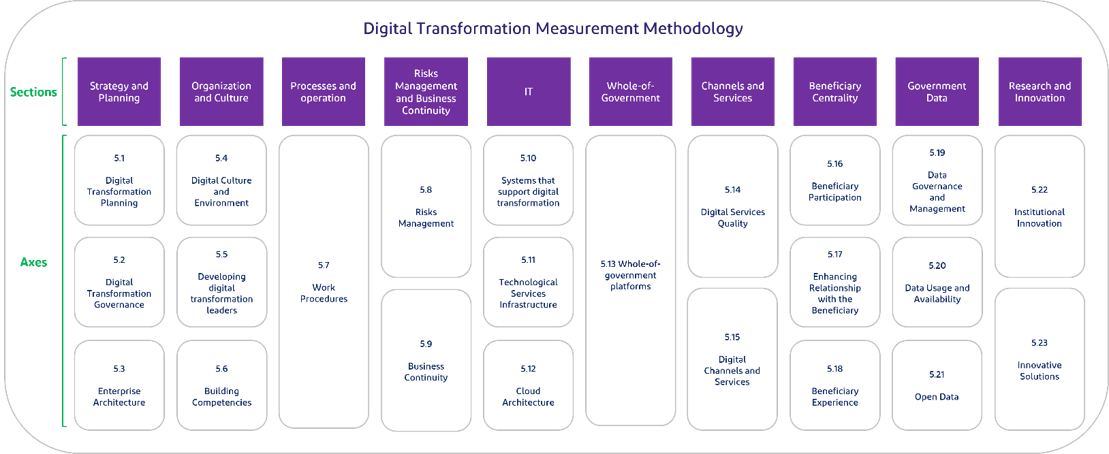
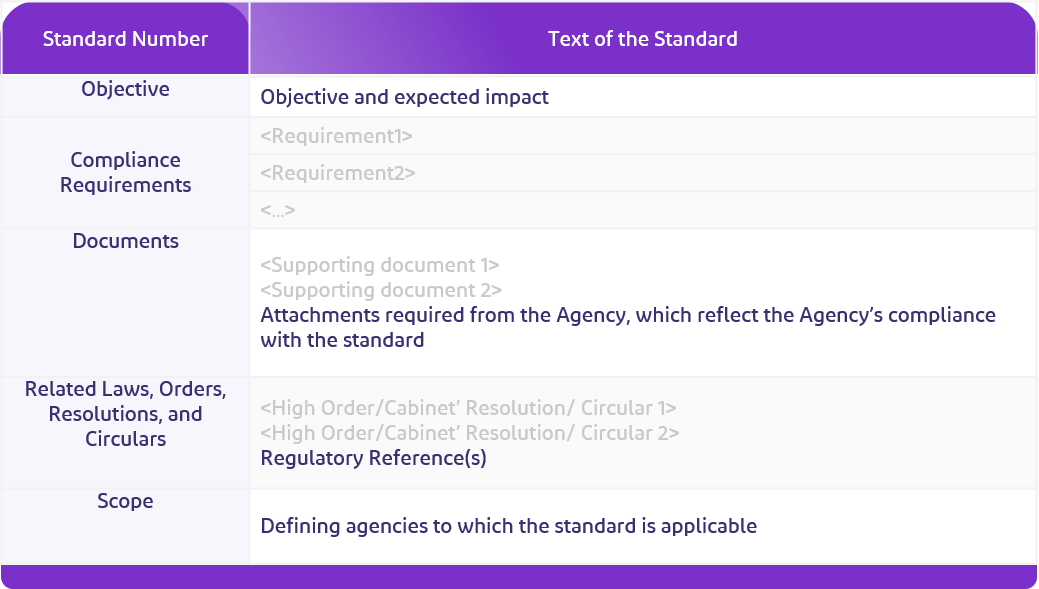
Figure (2) shows the structure of the standards card. The card included the "number and text of the standard" related to the axis, in addition to the "objective" of applying the standard and the expected results. The card also included the “compliance requirements” that explain and clarify the main requirements for applying the standard (with sequential or non-sequential conditions or specific steps). The standard card contains "proof documents" that clarify the mechanism for verifying the application of the standard, whether it is a report, document, attachment of a specific plan, forms, or certificate, as stipulated in the document. The card highlights the orders, decisions, circulars, and the like related to digital transformation. The card specifies the relevant government agencies, which must apply that standard; the scope may include all government agencies or be allocated to specific agencies. These agencies have been identified and updated in the list of government agencies concerned with the application of those standards.
The DGA prepared this document to define the digital transformation standards that government agencies must apply and adhere to, in accordance with the following:
It includes three main axes aimed at developing strategic plans for digital transformation, according to the following:
It includes three principal axes aimed at enhancing the digital culture of the Agency's employees, according to the following:
It includes a main axis aimed at designing and documenting work procedures and processes in the government agency, according to the following:
It includes two main axes aimed at enhancing the agency's ability to identify risks that would affect the continuity of digital government services, according to the following:
It includes three principal axes aimed at fulfilling the requirements of the application and systems architecture that support digital transformation, according to the following:
It includes a central axis aimed at promoting the application of the whole-of-government approach, according to the following:
It includes two main axes aimed at identifying all channels through which the agency can provide the services, according to the following:
It includes three main axes aimed at enhancing the role of the beneficiary and transforming it into an effective partner in the development and improvement of digital government services, according to the following:
It includes three main axes aimed at implementing the regulations and standards related to government data and its development mechanism, according to the following:
It includes two main axes aimed at adopting innovation and sustaining the innovative environment, according to the following:
For more information; Check the digital version.
138 Visitors Said Yes from 162
Suggestions and comments
For any inquiries or comments about the services or the current page, please fill in the required information.
Add Comment