
 Night Mode
 Maximize
 Minimize


All links to official websites of government agencies in the Kingdom of Saudi Arabia end with .gov.sa

Secure websites in the Kingdom of Saudi Arabia use the HTTPS protocol for encryption.



 Published 14/03/2023
 Night Mode
Maximize
Minimize
Night Mode
Maximize
Minimize
 Published 14/03/2023
Night Mode
Maximize
Minimize
Published 14/03/2023
Night Mode
Maximize
Minimize


These guidelines aim to be a reference for government entities to help the government entities build the most important procedures and processes that will increase their flexibility to respond to crises and restore their services in a flexible and smooth manner to contribute to the continuity of service provision and enhance the stability of national security in the Kingdom, these guidelines also support to comply with the Business continuity standards and Risk management controls in the digital government.

 Once-Only Principle
 Digital-first
 Mobile-first
 Digital by default
 Government as a Platform
 Digital by design
 Open by default
 Ease of policy Formulation
In order to achieve the objectives of Vision 2030 to enhance the reliability and continuity of digital services in government entities, the Digital Government Authority has prepared the " Guidelines of Business Continuity Management in Digital Government” to emphasize the importance of adopting the principles of Business Continuity given the rapid changes and current events surrounding digital business and services in government entities, which could impact its business continuity and the beneficiaries’ experience.
Enabling Business Continuity Management is a basic principle in ensuring the sustainability of the government entity’s business and its ability to recover business and services through specific resources and technologies within a specific time. Business Continuity Management and Disaster Recovery contributes to maintain the ability of the government entity to deal with unexpected risks and reduce the possibility of their occurrence or impact, through the fast response, and improve stakeholders‘ trust and empower the government entity to effectively activate Media Communication Plans during crises. The system also helps to raise the entity’s maturity level until it reaches the stage of organizational resilience to face crises and disasters, and reduces the fentity.
This document is a reference for government entities to help comply with “Controls of Business Continuity Management for Digital Government” issued by the Digital Government Authority “DGA” in order to raise the level of effectiveness of implementing and operating services digital in government entities.
inancial, legal, regulatory, operational and reputational consequences of the government
This guideline has been prepared for the purpose of guidance and to provide general guidance and does not represent professional advice and does not replace the requirements in local and international standards.
Business continuity management operations in the government entity is based on the facts and circumstances surrounding its operating environment, relevant external parties, regulatory requirements for Business Continuity Management Standards issued by the authority and other regulatory entities, and international best practices.
Enhance the resilience of government entities to respond to any disruptions and enable them to recover their main operations and services through guiding government entities, suppliers and operators of digital government services to implement and maintain an effective management system that provides the necessary capabilities to continue the business operations while facing any disruption, as well as comply with legal and regulatory requirements.
Additionally, this guideline provides guidance to enhance business continuity practices in government entities as per the methodology of Plan, Do, Check, Act (PDCA), as shown in the Figure (1) below:
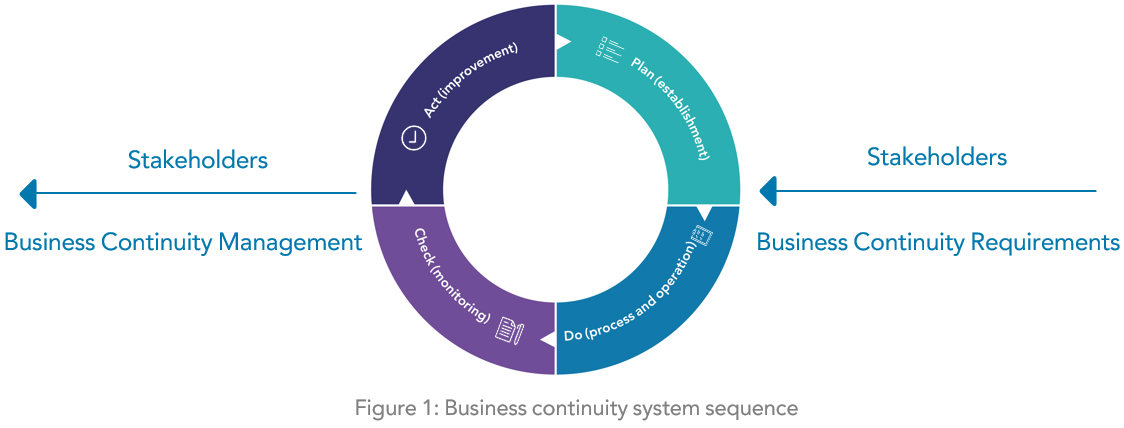
The recommendations contained in this document can be used by government entities that provide digital services and products and operators regardless of their type, size and nature. The applicability of the recommendations will depend on the entity's operating environment, level of complexity and number of its geographical locations.
For more information; Check the digital version.
| Term | Definition |
|---|---|
| DGA | Digital Government Authority. |
| Government Entities | Ministries, authorities, public institutions, councils, national centers including any additional form of a public entity. |
| Business Continuity (BC) | The ability of the entity to continue its prioritized activities at predetermined levels after the occurrence of a disruptive incident |
| Business Continuity Strategy (BC Strategy) | The method of an entity to plan in order to recover and continue after a disruptive event. |
| Business Continuity Management System (BCMS) | A part of the overall management system that establishes, implements, operates, monitors, reviews, maintains and improves business continuity. |
| Business Continuity Plan (BCP) | Documented information that guides an entity to respond to a disruption and resume, recover and restore the delivery of products and services consistent with its business continuity objectives. |
| Organizational Flexibility | The organization's ability to assimilate and adapt in a changing environment to enable it to achieve its goals, survive and thrive. |
| Information Technology (IT) Disaster Recovery (DR) | Digital technology to recover its critical systems to an acceptable level within a predetermined period of time following a disruption. The ability of the IT DR elements of an entity including all. |
| Impact | The impact is the consequence of the risk if it’s materialized. |
| Event | Any event that has a consequence that may affect the achievement of objectives, negatively or positively. |
| Resources | Resources include information, skills, people, technology, suppliers, assets and premises, which are obtained and used by an entity to achieve its organizational goals and objectives. |
| Stakeholders | Parties and entities that affect and are affected by decisions, directions, procedures, objectives, policies and initiatives of the digital government and share some of their interests and outputs and are affected by any change that occurs in them. |
| Target Recovery Time (RTO) | Period of time following an incident within which a product and service or an activity or resources are recovered. |
| Recovery Point Objective (RPO) | Point to which information used by an activity is restored to enable the activity to operate on resumption. |
| Maximum Tolerable Period of Disruption (MTPD) | Time it would take for adverse impacts, which might arise as a result of not providing a product, service or performing an activity, to become unacceptable. |
| Minimum Business Continuity Objectives (MBCO) | Minimal level for a product or service, which are considered appropriate for the entity to still accomplish its organizational goals after disruption. |
| Business Impact Analysis (BIA) | Process for analyzing business activities and the impacts over time of a disruption on the entity. |
| The Crisis | An abnormal and unstable situation that threatens the strategic objectives of the entity, their reputation or survival. |
| Compliance | Extent to which requirements are fulfilled. |
| Continuous Improvement | Recurring activity to enhance performance of the BCMS. |
| Disruption | An incident, whether anticipated or unanticipated, that causes an unplanned, negative deviation from the expected delivery of products and services according to an entity’s objectives. |
| Exercises | Activity in which the business continuity plans are rehearsed in part or whole to ensure that the plans contain the appropriate information and produce the desired results when activated. |
| Internal Audit | A compliance review against BCM standard or policy requirements. |
| Management Review | Management’s review for a certain situation or reconsideration of a certain topics. |
| Media Response Plan (MRP) | A plan providing details of the entity’s media response following an incident, including a communications strategy. |
| Remote Working | A work system in which the worker performs his job duties for the benefit of his employer, and under its supervision, in a place other than the usual workplace at the headquarters of his workplace inside the Kingdom, whether the work is full or part time, using means of communication and information technology. |
| Performance Appraisal | Used to check how well roles and responsibilities are being undertaken. |
| Prioritized Activities | Activity to which urgency is given in order to avoid unacceptable impacts to the business during a disruption. |
| Process | A set of interrelated or interacting activities which transforms inputs into outputs. |
| Recovery | Documented processes to restore and return business activities from the temporary measures adopted during and after a disruption. |
| Test | This is an activity or action that is undertaken to gauge the capabilities and effectiveness of a strategy or plan against a predetermined criteria or benchmark. (This shall include a pass/fail element) |
| Top Management | All those responsible for making key decisions within the entity. |
| Training | This activity is more formalized compared to awareness. It purports to build skills and competencies to increase the performance of staff regarding a specific role or responsibility |
| Enterprise Risk Management (ERM) | Risk management involves understanding, analyzing, and addressing risk to make sure organizations achieve their objectives. |
| Risk | Events that might occur and effect the achievement of the entity objectives. |
| Risk Tolerance (RT) | Reflects the acceptable variation in outcomes related to specific performance measures linked to objectives the entity seeks to achieve . (COSO ERM) |
| Risk Assessment | The process of identifying, analyzing and evaluating the risks that might impact the achievements of objectives. |
| Abbreviations | Description |
|---|---|
| RTO | Recovery Time Objective |
| RPO | Recovery Point Objective |
| MTPD | Maximum Tolerable Period of Disruption |
| MBCO | Minimum Business Continuity Objective |
| BIA | Business Impact Analysis |
38 Visitors Said Yes from 42
Suggestions and comments
For any inquiries or comments about the services or the current page, please fill in the required information.
Add Comment