





 Published 02/07/2025
1. Preamble
Based on Council of Ministers Resolution No. (418), dated 25/07/1442H, which approved the establishment of the Digital Government Authority, and pursuant to Paragraphs (5) and (10) of Article (4), the Authority is entrusted with the responsibilities of "issuing measurements, indicators, tools, and reports to assess the performance and capabilities of government agencies in the field of digital government, as well as beneficiary satisfaction," and "providing support to government agencies regarding digital government services to facilitate the adoption and enablement of emerging technologies."
In line with the Authority’s commitment to effectively supporting government agencies in achieving their objectives and ensuring compliance with the "Digital Government Policy," which emphasizes the integration of emerging technologies to accelerate digital transformation across various sectors, the Authority has launched the "Emerging Technology Adoption Readiness Index." This index is designed to assist government agencies in assessing their current readiness to adopt emerging technologies, identifying gaps and opportunities for improvement, and providing the necessary plans to develop capabilities that align with their institutional needs, ensuring the strategic and sustainable realization of the intended benefits.
This report for the year (2025) presents the results recorded by government agencies in the (third) cycle of the Emerging Technology Adoption Readiness Assessment. Additionally, it briefly highlights select success stories, categorized by their respective sectors.
The objective of the report
This report aims to provide an overview of the "Emerging Technology Adoption Readiness Index" for the year (2025), its objectives, the agencies included, and the criteria used for their selection. It also addresses the capabilities, elements, and standards on which the Index focuses, as well as the mechanisms for measuring them. Furthermore, it aims to showcase the most prominent success stories of the included sectors, the overall result of the Index, and the results achieved by the agencies; in accordance with the following four capabilities: Research, Communicate, Prove and Integrate.
2. Introduction
2.1 Overview of emerging technologies globally
2.1.1 Emerging technologies
Modern technologies that support the implementation of digital government activities, which its applications still under development. These technologies are typically more efficient, higher in quality, or faster in performance compared to traditional methods and technologies. Examples of emerging technologies include:
3D printing
Robotics
AR / VR
Blockchain
IoT
AI
2.1.2 Global impact of emerging technologies
The global adoption of emerging technologies is reshaping economies, societies, and industries at an unprecedented pace, marking a transformative era in which innovation is not just a competitive advantage but a necessity. Technologies such as Artificial Intelligence (AI), robotics, the Internet of Things (IoT) and blockchain, are at the forefront, redefining how organizations operate, integrate, and deliver value. This shift is global in scope, influencing developed and developing countries alike, as both public and private sectors invest heavily in digital solutions to enhance efficiency, drive economic growth, and solve complex societal challenges.
In recent years, we have seen how emerging technologies can improve flexibility, smoothness, and scalability across various sectors, from healthcare and education to finance and manufacturing. These technologies have unlocked new ways to gather and analyze data, automate tasks, and create personalized experiences, ultimately leading to higher productivity and more informed decision-making. Nations worldwide recognize the strategic importance of adopting these technologies, which not only promise economic benefits but also offer solutions to critical issues like climate change, healthcare accessibility, and infrastructure sustainability.
However, the journey toward comprehensive technology adoption is not without challenges. Concerns over data privacy, cybersecurity, workforce displacement, and the digital divide, as well as implementation difficulties, underscore the complexities of this transition. For countries looking to harness the full potential of emerging technologies, balanced approaches that prioritize responsible innovation, regulatory clarity, and equitable access are essential.
The following section provides an overview of the global impact of emerging technology adoption, highlighting key trends and opportunities. It explores how different nations are navigating this technological landscape. By understanding the transformative power of these technologies and the varied approaches to their adoption, stakeholders can gain valuable insights into the future of a connected, technology-driven world and the pathways to sustainable growth and innovation.
2.1.3 Emerging technology trends for the coming years
Emerging technologies refer to modern, rapidly growing innovations that provide creative solutions and innovative methods. These technologies are expected to reshape industries, enhance economies, and drive widespread societal progress. Whether they stem from entirely new inventions or incremental advancements of existing technologies, emerging technologies evolve through pioneering developments in various fields of science and engineering. They continuously push the boundaries of what is possible, exploring new horizons. These technologies manifest across a broad spectrum, from the microscopic scale of nanotechnology to large-scale scientific projects such as Geneva’s Large Hadron Collider (LHC). These innovations span various fields, such as quantum computing, sustainable energy, and smart cities, highlighting the broad impact of these technologies. This section reviews the most prominent strategic trends in emerging technologies for 2025, focusing on their significance and impact.
2.1.4 Global Adoption & Future Trends of Emerging Tech
Emerging technologies are advancing at a rapid pace, paving the way for transformative changes in economic and social structures on a global scale. Preparing for the adoption of these technologies is crucial to harness their benefits while minimizing potential risks. The job market, for instance, must proactively anticipate and equip the workforce with skills that align with future demands, ensuring a supply of talent that corresponds with the needs of emerging fields. Meanwhile, governments play a pivotal role in planning for uncertainties and establishing regulatory frameworks that enable the safe and effective integration of these innovations into existing systems. The rate at which these technologies are adopted globally depends on several factors, including their stage in the lifecycle, industry requirements, and the level of public trust and regulatory support. The interrelation of these factors is reflected in the following points:
Influence of Phase in Adoption Lifecycle: Emerging technologies tend to gain adoption momentum as they progress from experimentation to proof-of-concept stages, facilitating their transition toward implementation and practical use.
Sector-Specific Adoption Rates: Sectors with high operational costs and specialized applications, such as bioengineering and space exploration, often face slower adoption rates due to their unique industry requirements.
Future Impact of Key Technologies: Emerging fields like AI, biotechnology, quantum computing, and immersive technologies are expected to drive a significant leap in healthcare, finance, data processing, and education.
Dependency on Skilled Workforce and Trust: The availability of a workforce with specific skillsets, public confidence, and the presence of supportive regulatory readiness are crucial factors that influence how rapidly and effectively new technologies are adopted.
3."Overview" of Emerging Technology Adoption Readiness Index
3.1 Emerging technologies adoption readiness in the public sector
Emerging technologies are one of the most important drivers of transformation and development in the public sector, as these technologies could radically modernize and improve government operations, which contributes to enhancing the efficiency of services provided to citizens and achieving the strategic goals of governments. The impact of emerging technologies in the public sector ranges from improving communication and interaction with citizens to developing public policies and improving service performance. Enhancing transparency and effectiveness in resource management and service delivery is one of the key aspects that reflects the importance of emerging technologies in the public sector. By using big analytics, artificial intelligence, and cloud computing, governments can improve decision-making processes and data analysis to achieve better and faster results.
3.2 Emerging Technology Adoption Readiness Index
The Authority emerging technologies adoption readiness index comes as a periodic assessment conducted through a measurement methodology based on four basic capabilities (Research, Communicate, Prove, and Integrate). In general, this assessment can be relied upon by the departments responsible for research, development, technical affairs and innovation in the agency, as its results help them determine the current level of readiness to adopt emerging technologies, monitor the gaps, and plan the steps that should be taken to build capabilities that guarantee success when adopting these technologies to achieve the desired benefits.
3.3 Objectives of the Emerging Technology Adoption Readiness Index
Emerging Technologies Adoption Readiness Index seeks to achieve several important objectives at the level of government agencies in the public sector:
Accelerating the realization of benefits from Emerging Technologies
Supporting government agencies in their journey to adopt Emerging Technologies
Contribute to achieving the strategic objectives of Digital Government
3.4 Improvement and development of the evaluation framework
Continuous development is one of the most important features of emerging technologies, as it provides beneficiaries with the tools and capabilities that enable them to invest their full potential. These advancements often lead to many benefits, such as cost reduction, increased efficiency, enhanced user satisfaction, and delivering unique experiences that meet individual needs. As part of the Authority’s ongoing commitment to accurately reflect the state of emerging technology adoption, the authority has added new elements and criteria to the 'Emerging Technologies Adoption Readiness Index' framework. These additions include assessing the readiness to adopt mainstream technologies and their applications, such as artificial intelligence. It assesses an agency's readiness to adopt AI applications, the speed and extent of adoption, and its impact on efficiency, to provide a more comprehensive and accurate view of how AI technologies are being adopted across different sectors.
3.5 Focus Technology (2025): Artificial Intelligence
This year, the Focus Technology of the index measures the extent to which government agencies have adopted AI technologies, one example of which is Generative AI. This type of AI relies on huge amounts of training data to produce text, images, sounds, and code in response to user requests and has seen a major surge in popularity and positive impact in recent years. It also contributes to reducing time, cost, and effort to reach the desired results, significantly improving end-user productivity. Advances in Generative AI have revolutionized many industries by automating repetitive tasks and facilitating time-consuming creative processes. For example, AI tools can now write articles, create digital artwork, and compose music effectively, giving creators greater freedom to focus on more critical activities. In the field of software, AI can write and correct code, reducing errors and accelerating the development process. In addition, the integration of Generative AI into everyday applications has reshaped user experiences, as personalized recommendations, chatbots, and virtual assistants have become more sophisticated and interactive. This development not only ensures a seamless user experience but also enhances the efficiency of daily operations.
The Emerging Technologies Readiness Index also seeks to measure the maturity of government agencies in adopting a variety of modern technologies. The index annually focuses on the most innovative and impactful technologies and provides a comprehensive insight into the readiness of agencies to adopt these technologies within their strategies effectively, enhancing innovation and operational efficiency. This broad focus not only sheds light on AI but also contributes to building a deeper understanding of how government agencies integrate with emerging technologies and their ability to adapt to future transformations for a sustainable competitive advantage
3.6 Emerging Technologies Adoption Readiness Index Framework
3.6.1 Emerging Technologies Adoption Readiness Index Framework for the year (2025)
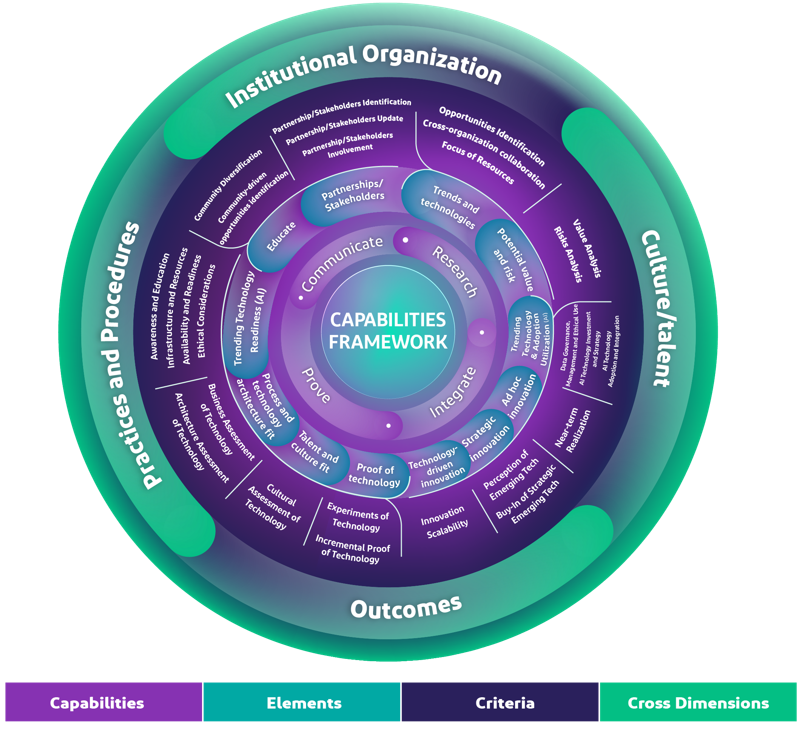
he adjacent figure shows the framework that was developed and designed to assess the readiness of government agencies to adopt emerging technologies. This framework consists of:
(4) main capabilities (Research, Communication, Prove, and Integrate).
(12) elements branching out from the four capabilities.
(26) criteria stemming from these elements.
(4) cross-dimensions for all the elements.
3.6.2 The four key capabilities that are assessed Within the framework of the Emerging Technologies Adoption Readiness Index
Research
Communicate
Prove
Integrate
3.6.3 Evaluation mechanism
Emerging technologies adoption readiness was assessed according to the following three stages:
First Stage: Current State Assessment
This stage involves assessing the current state of participating agencies and defining the agencies' Readiness to Adopt Emerging Technologies. This assessment is based on the data and evidence provided by the covered agencies during the evaluation sessions that were held.Second Stage: Readiness Level Determination
At this stage, readiness levels were determined by analyzing the data collected during the first stage, processing the inputs, and calculating points within each of the four capabilities, where the level of readiness progress in each agency was determined based on the result of assessing its current situation, and applying the readiness determination equation. Which shows the agency’s capabilities within the five levels of readiness.Third Stage: Recommendation and Action Plans
It's crucial to provide intuitive suggestions and pinpoint specific actions within each of the capability dimensions analyzed. By taking this approach, the organization can leverage the results as a roadmap to progress from its current state to the next maturity level of the assessment. By establishing these key elements, we can offer targeted and tailored support relevant to the unique needs and objectives of the agency.
3.6.4 Classification of emerging technologies adoption readiness level
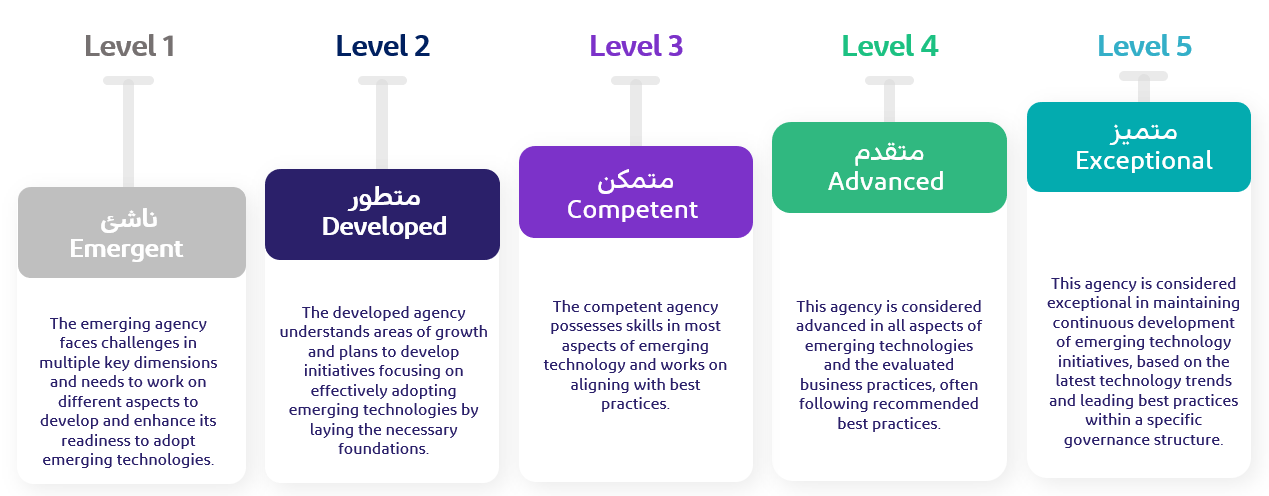
The level of government agencies readiness is determined according to the result of emerging technologies adoption readiness index, according to the capabilities and their sub-criteria in each measurement cycle within one of the following five levels:
4. Sectors represented in the third cycle (2025)
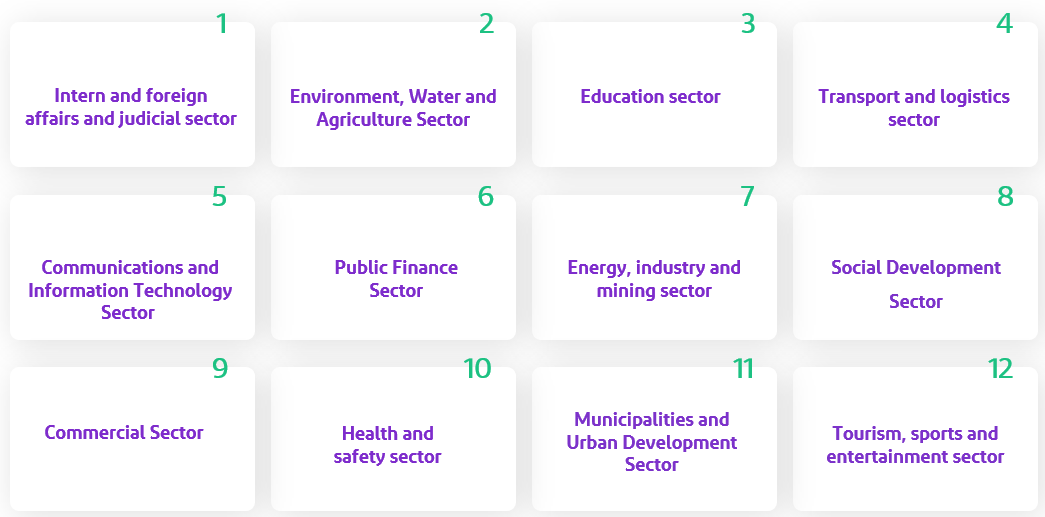
The authority has been working on enhancing the index mechanism since the announcement of its first cycle on February 9, 2023, refining several elements to make them clearer and more comprehensive. In the second cycle, the performance of 35 government agencies across various sectors was assessed, and these agencies were selected based on specific criteria. For the third cycle in 2025, the authority aims to expand the number of agencies measured by the index, with the goal of achieving a broader and more comprehensive vision of the performance of different government agencies, which were selected based on specific criteria.
5. Summary of government agencies general evaluation and results
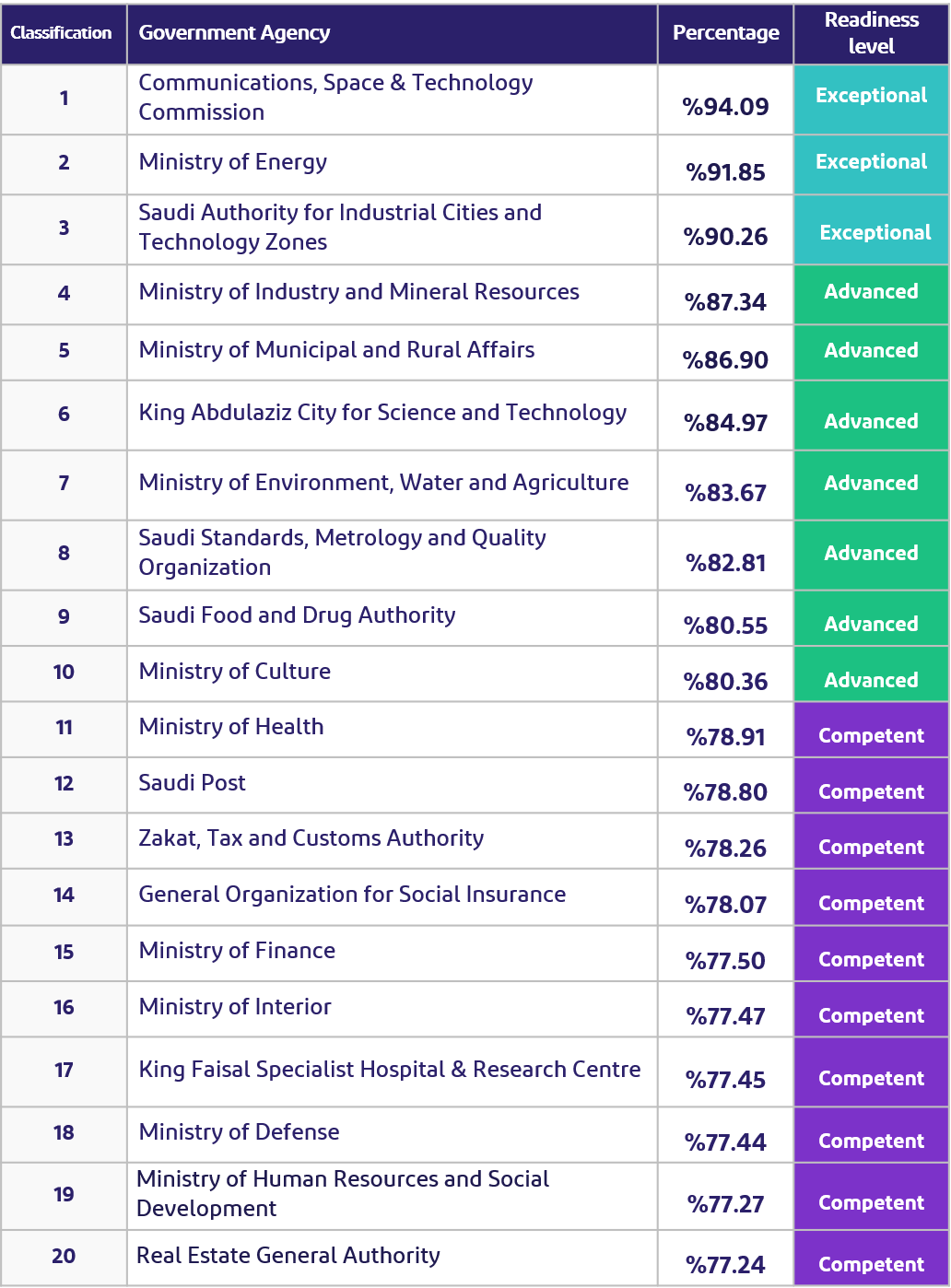
5.1 The Top Government Agencies in the Third Cycle of the Emerging Technologies Adoption Readiness Index (2025)
For more information: Check the digital version.
Suggestions and comments
For any inquiries or comments about the services or the current page, please fill in the required information.
Add Comment