





 Published 27/11/2022
1. Preamble
In the implementation of the Cabinet Resolution No. (418) dated 25/07/1442 AH, approving the organization of the Digital Government Authority, which states in Article (3) that “The Authority shall be the competent authority in everything related to the digital government, and the national reference in its affairs”, the sixth paragraph of Article (4) “Without prejudice to the competencies of the relevant authorities, the Authority shall undertake the following functions and tasks: Follow up on the commitment of government agencies to issued decisions and orders regarding digital government transactions in accordance with the frameworks and standards set by the Authority”, according to what was stated in item (Fourth) of the Resolution, the Ministry of Communications and Information Technology shall take the necessary measures regarding the cancellation of the e-Government Transactions Program (Yesser), issued by the Royal Decree No. (22290) dated 04/27/1433 AH, and Royal Decree No. (18767) dated 7/4/1440 AH, which stipulated that the “Digital Government Authority” shall replace the program in projects and initiatives for which resolutions were issued by the Council of Ministers and related Royal Decrees.
The report contains the results of the participating government agencies included in the Ninth Measurement Cycle 2021, as the evaluation relied entirely on the data provided by government agencies to the Authority. The results shown in this summary represent the agencies' response to the requirements of indicators for measuring government digital transformation.
2. About the Measurement 2021
“Measuring Government Digital Transformation” in its ninth edition aims to contribute to the development of digital government by following up periodically and motivating it in line with the trends in the field of digital transformation to achieve the objectives of the Kingdom’s Vision 2030 and its executive programs, as it works on evaluating and determining the current situation of government agencies and measuring their digital transformation through a unified general framework to ensure the achievement of digital transformation in all its stages, seeking to motivate government agencies to work on developing competencies, raising the level of performance, and empowering government agencies by providing a digital mechanism to assess and measure their transformation and the extent of their performance development during the year to reach an integrated digital government.
The current measurement is an extension of the eighth measurement, as the stages of digital transformation have been maintained, with the names of some stages modified to be more clear, with a series of updates to the measurement (the ninth), based on the learned lessons and the views of government agencies.
3. Concept of Digital Transformation
Seeking to achieve organizational strategy and develop innovative and flexible business and operating models by employing technologies, developing talent, reorganizing operations, and managing change to create added value and new experiences for beneficiaries, employees, and stakeholders.
What is Measurement?
An assessment tool based on a specific methodology that targets government agencies to diagnose their current situation and follow up on the development of their journey in digital transformation by best practices and standards, which contributes to achieving the objectives of the Kingdom's Vision 2030.
5. Measurement Objectives
- Supporting government agencies' journey towards digital transformation.
- Providing a methodology and tools for evaluating digital transformation.
- Enabling innovation and adopting emerging technologies.
- Managing corporate planning for government digital transformation.
- Spreading a culture of developing services and measuring beneficiary satisfaction.
- Raising awareness of government digital transformation.
- Accuracy of updating databases and information.
- Enhancing transparency and E-participation.
6. Measurement Indicator Approach
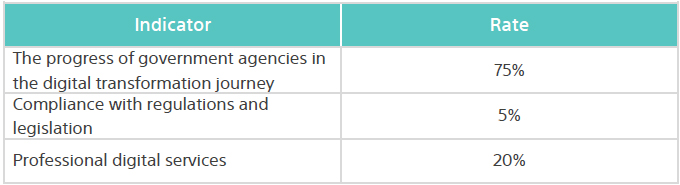
The government digital transformation measurement indicator consists of three sub-indicators through which the level of progress of government agencies in the field of digital transformation is measured.
- First Sub-Indicator: The progress of government agencies in the digital transformation journey
This indicator is responsible for measuring the level of transformation of government agencies according to the dimensions and sub-dimensions of the digital transformation journey.
- Second Sub-Indicator: Compliance with regulations and legislation
This indicator is responsible for measuring the extent of government agencies' compliance with government regulations and legislation related to the digital transformation journey.
- Third Sub-Indicator: Professional digital services
This indicator is responsible for measuring the level of professionalism of digital services.
A specific rate has been determined for each of these indicators, as shown in the following table:
First Sub-Indicator: the level of progress of government agencies in the digital transformation journey
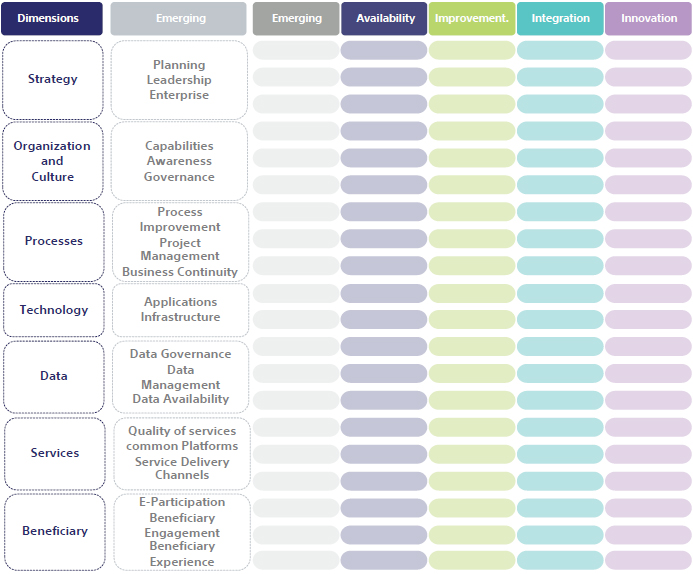
The first indicator includes a framework for the digital transformation journey consisting of seven main perspectives that cover the most important aspects of the digital transformation process in a harmonious and integrated manner. Through these perspectives, the indicator measures the level of the agency's progress in the digital transformation journey.
From each of these dimensions, a group of 20 sub dimensions is branched out, measured from across 20 different indicators.
The following figure illustrates the current framework for the ninth measurement:
7. Digital Transformation Journey
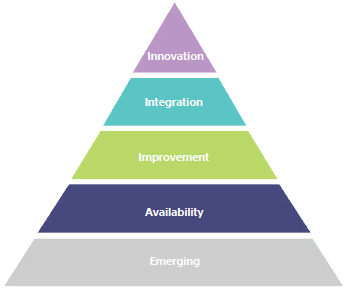
The progress of government agencies in the digital transformation journey is measured based on each of these dimensions, so that the agency moves in its journey towards digital transformation in five successive stages, each of which expresses a specific level of progress:
- Emerging Stage:
In this stage, the government agency shall establish initial steps towards digital transformation.
- Availability Stage:
In this stage, the agency shall have finalized the plans, and developed standards and proper tools for digital transformation.
- Improvement Stage:
During this stage, the agency shall work on the continuous development and monitoring of all aspects of digital transformation with the aim of continuous improvement.
- Integration Stage:
At this point, the agency shall have achieved internal and external integration, achieving a key component of digital transformation.
- Innovation Stage:
At this point, the agency must have adopted innovation models in the context of digital transformation, taking advantage of emerging technology.
The following figure shows the stages of the digital transformation journey:
Second Sub-Indicator: Compliance with Regulations and Legislation
The extent of government agencies' compliance with government regulations and legislation related to the digital transformation process is measured through this indicator, based on four levels:
- Fully compliant.
- Partially compliant.
- Non-compliant.
- Not Applicable.
Third Sub-Indicator: Professional Digital Services
The Government Services Observatory helps government agencies identify and publish their digital services, develop a road map for converting traditional services in government agencies into digital services, and help assess the level of government agencies’ progress in the transition to digital services, knowing that this indicator is measured semi-annually.
8. Criteria for the Nomination of Agencies in 2021
The Digital Government Authority, based on the ninth measurement methodology, has developed a set of criteria to identify the segment of the measurement target audience. These criteria include:
To be a government agency.
The agency hall be administratively independent and have a legal personality.
To be financially independent.
The agency provides services to the external beneficiary, whether government agencies, the private sector, individuals, or the internal beneficiary (employees of the government agency.
For the newly established agencies of the Council of Ministers, it is required that 18 months have passed since its establishment.
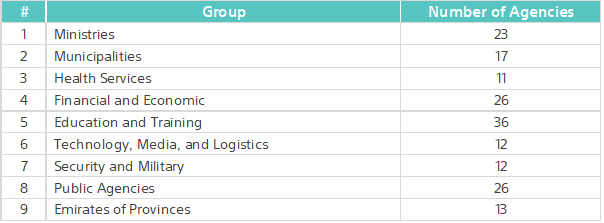
Based on the above, 193 government agencies were measured, of which 17 participated in the ninth measurement for the first time. Accordingly, their results are not counted among the agencies included in this report. As for the remaining 176 government agencies, they will be detailed in this report.
Classification of Government Agencies into Groups
Within the framework of the improved work for the ninth measurement, the Digital Government Authority followed a specific classification of government agencies, as government agencies were classified according to the nature of their work and the services they provide to beneficiaries in a harmonious and homogeneous manner, and this classification allows for comparison between these agencies in their journey towards digital transformation effectively and clearly.
The Results of Government Agencies in the Ninth Measurement
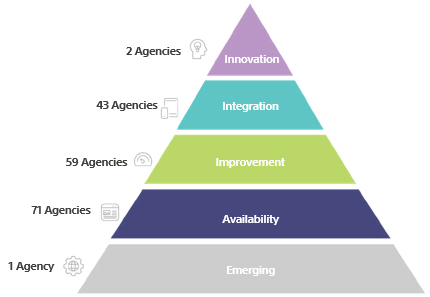
The government agencies have made progress in the ninth measurement compared to what they have made in the eighth, with an improvement rate of 3.89%. This chapter reviews the results of the 176 government agencies participating in the ninth measurement of digital transformation.
The results of the evaluation of government agencies were as follows:
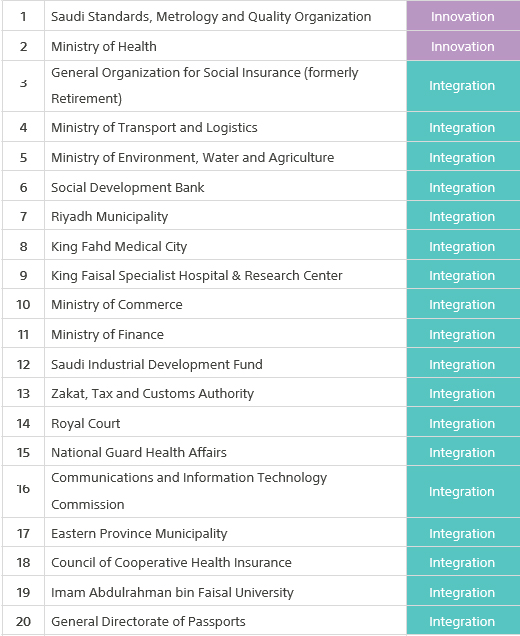
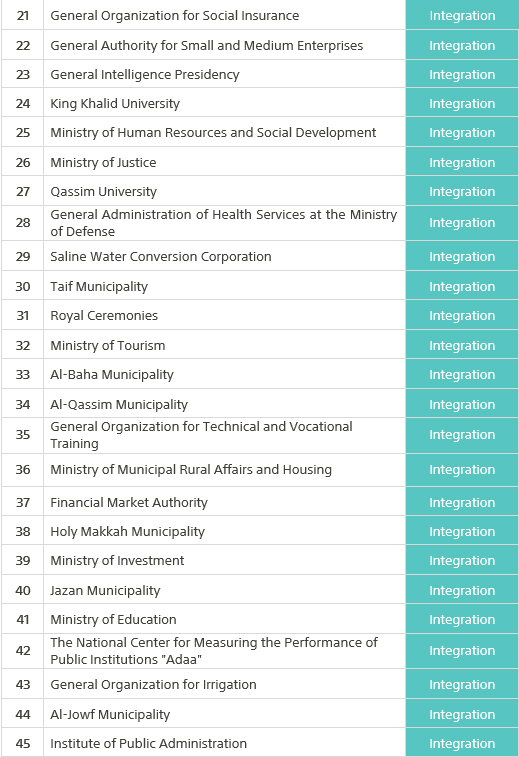
9. Top Government Agencies In Measurement
Results by Group
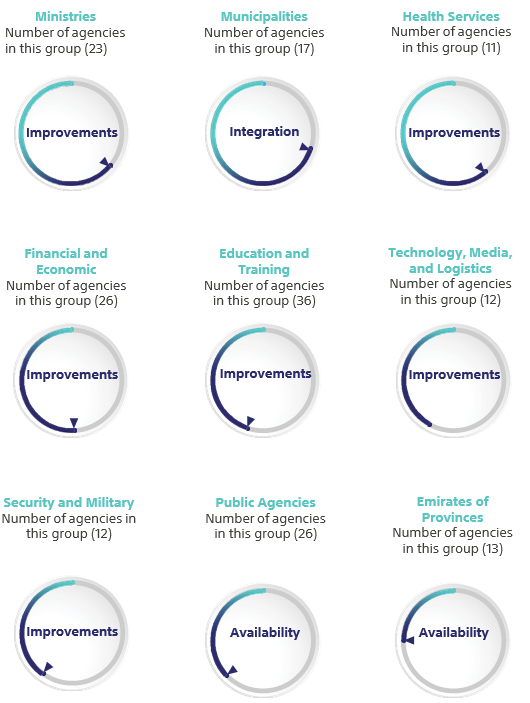
First: Ministries Group:
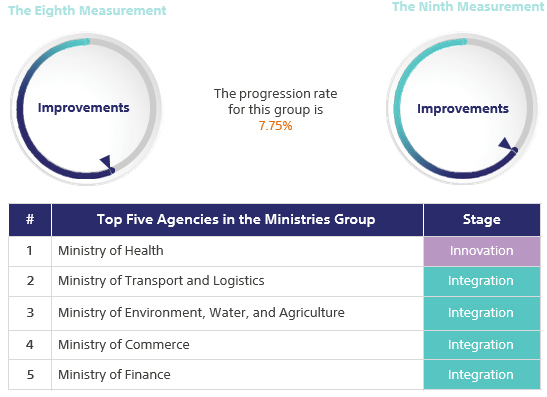
Governmental Agencies in the Ministries Group:
Ministry of Communications and Information Technology.
Ministry of Tourism.
Ministry of Human Resources and Development.
The Ministry of Investment.
Ministry of Islamic Affairs and Social Advocacy.
Ministry of Economy, Planning, and Guidance.
Ministry of Transport and Logistics.
Ministry of Information.
Ministry of Municipal and Rural Affairs.
Ministry of Environment, Water, and Agriculture.
Ministry of Commerce.
Ministry of Municipal and Rural Affairs and Housing.
Ministry of Education and Housing (formerly Housing).
Ministry of Hajj and Umrah.
Ministry of Health.
Ministry of National Guard.
Ministry of Industry and Mineral Resources.
Ministry of Foreign Affairs.
Ministry of Energy.
Ministry of Defense.
Ministry of Justice.
Ministry of Sports.
Ministry of Finance.
Second: Municipalities Group:
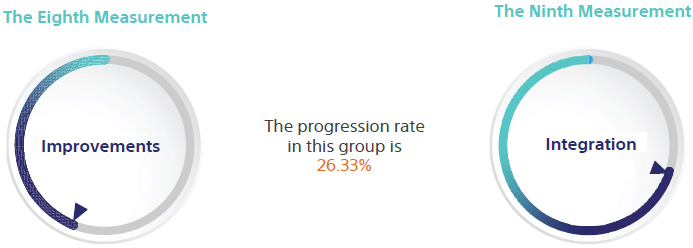
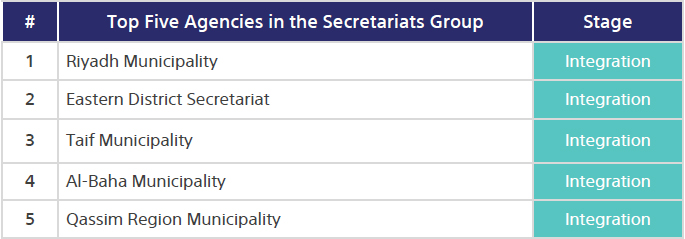
Governmental Agencies in Municipalities Group:
Holy Makkah Municipality.
Eastern Province Municipality.
Al-Ahsa Governorate Municipality.
Taif Governorate Municipality.
Jeddah Municipality.
Hafr Al-Batin Governorate Municipality.
Al-Baha Municipality.
Al-JowfMunicipality.
Municipality of the Northern Border Region.
Riyadh Municipality.
Qassim Region Municipality.
Al-Madinah Al-MunawwarahMunicipality.
Tabuk Region Municipality.
Jazan Region Municipality.
Assir Region Municipality.
Najran Region Municipality.
Third: Health Services Group:
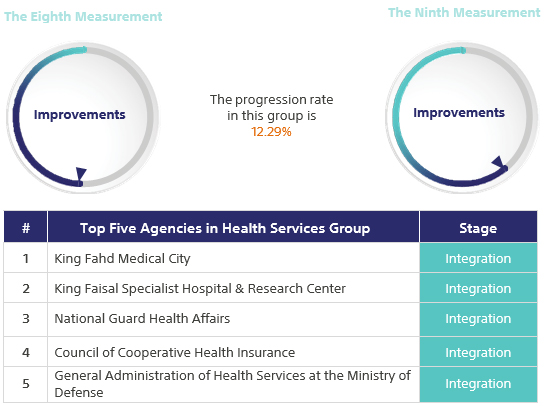
Governmental Agencies in the Health Services Group:
General Administration of Health Services at the Ministry of Defense.
General Administration of Medical Services at the Ministry of Interior.
National Guard Health Affairs.
Saudi Health Council.
Saudi Commission for Health Specialties.
General Authority for Food and Drug Administration.
Council of Cooperative Health Insurance.
King Fahd Medical City.
King Khaled Eye Specialist Hospital.
King Faisal Specialist Hospital & Research Center.
Saudi Red Crescent Authority.
Fourth: Financial and Economic Group
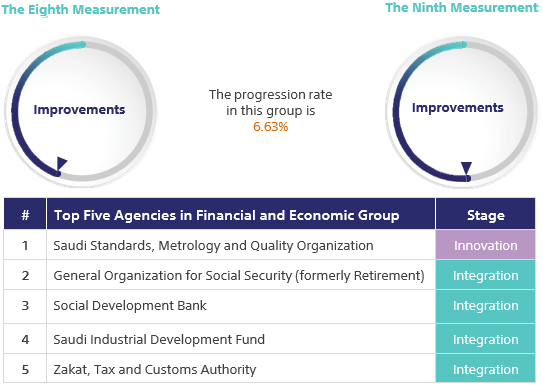
Governmental Agencies in the Financial and Economic Group:
Saudi Central Bank.
General Court of Accountancy.
Saudi Energy Efficiency Center.
General Organization for Social Insurance.
General Organization for Social Insurance (formerly Retirement).
General Grain Corporation.
Saudi Authority for Industrial Cities and Technology Zones.
Saudi Authority for Intellectual Property.
Saudi Standards, Metrology and Quality Organization.
General Authority for Statistics.
General Authority for Endowments.
Real Estate General Authority.
General Authority for Exhibitions and Conferences.
General Authority for Competition.
General Authority for Small and Medium Enterprises.
Social Development Bank.
Agricultural Development Fund.
Saudi Industrial Development Fund.
Real Estate Development Fund.
Human Resources Development Fund.
Zakat, Tax and Customs Authority.
Zakat, Tax and Customs Authority (formerly Customs).
Financial Market Authority.
Local Content and Government Procurement Authority.
Cities and Special Economic Zones Authority.
Saudi Export Development Authority.
Fifth: Education and Training Group:
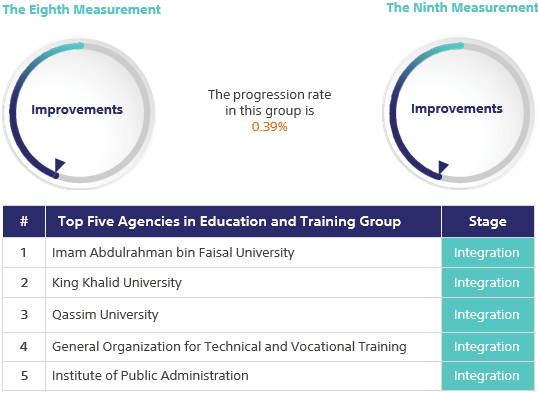
Governmental Agencies in the Education and Training Group:
The Islamic University of Medina.
The Saudi Electronic University.
General Organization for Technical and Vocational Training.
Imam Abdulrahman bin Faisal University.
Imam Muhammad Bin Saud Islamic University.
Prince Sattam bin Abdulaziz University.
Princess Nora bint AbdulRahman University.
Al Baha university.
Al-Jowf University.
Northern Border University.
Taif University.
Al Qussaim university.
University collected.
King Khalid University.
King Saud University.
King Saud bin Abdulaziz University for Health Sciences.
Institute of Public Administration.
King Abdulaziz Public Library.
King Fahd National Library.
Education and Training Evaluation Authority.
King Abdulaziz University.
King Fahd University of Petroleum and Minerals.
King Faisal University.
Umm Al Qura University.
University of Bisha.
Tabouk university.
Jazan University.
Jeddah University.
Hail University.
University of Hafr Al-Batin.
Shaqra University.
Taibah University.
Najran university.
King Abdulaziz Foundation.
King Khalid Military College.
King Fahd Security College.
Sixth: Technology, Media, and Logistics Group:
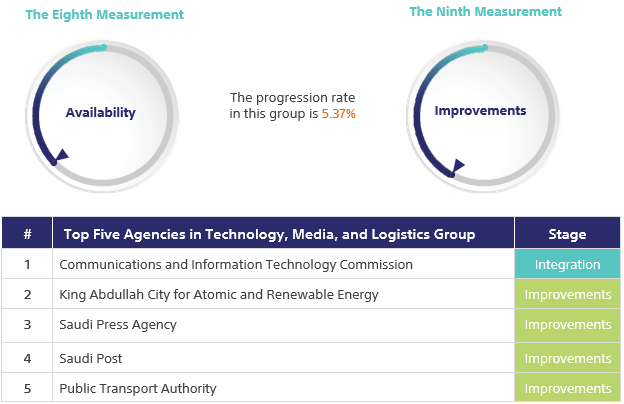
Governmental Agencies in the Technology, Media, and Logistics Group:
Saudi Post.
Saudi Space Authority.
General Authority for Audiovisual Media.
General Entertainment Authority.
General Authority of Civil Aviation.
General Authority of Ports.
Public Transport Authority.
King Abdulaziz City for Science and Technology.
King Abdullah City for Atomic and Renewable Energy.
Communications and Information Technology Commission.
Radio and Television Commission.
Saudi Press Agency.
Seventh: Security and Military Group:
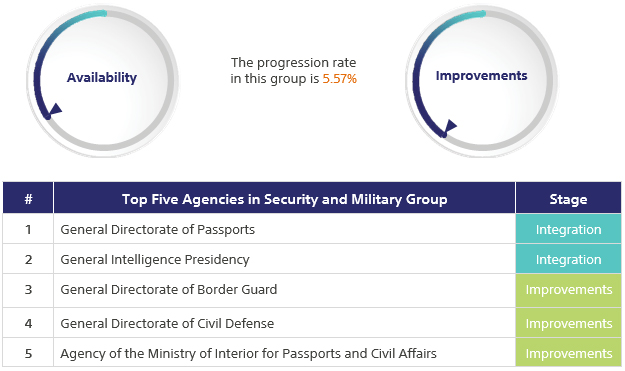 Governmental Agencies in the Security and Military Group:
General Directorate of Border Guard.
General Directorate of Passports.
General Directorate of Civil Defense.
Directorate General of Prisons.
General Directorate of Narcotics Control.
General Organization for Military Industries.
Public Prosecution.
General Authority for Military Industries.
General Intelligence Presidency.
Facilities security forces.
Directorate of general security.
Agency of the Ministry of Interior for Passports and Civil Affairs.
Eighth: Public Agencies Group:
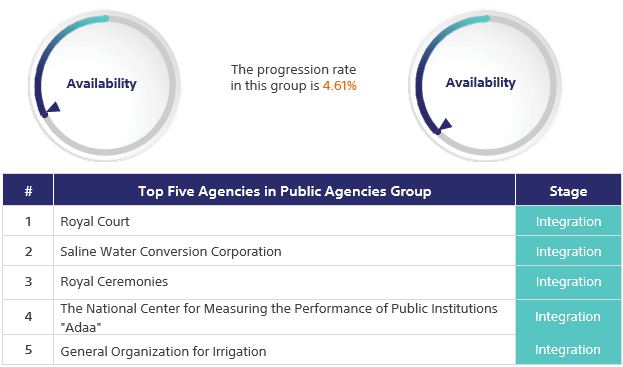
Governmental Agencies in the Public Agencies Group:
Royal Court
General Presidency for the affairs of the Grand Mosque and the Prophet's Mosque
The General Presidency for Scholarly Research and Ifta
The General Presidency of the Commission for the Promotion of Virtue and the Prevention of Vice
Royal Ceremonies
National Center for Wildlife Development
The National Center for Measuring the Performance of Public Institutions “Adaa”
National Center for Monitoring Environmental Compliance
National Center for Documents and Archives
Saline Water Conversion Corporation
General Organization for Irrigation
General Authority for Survey
The General Authority for Jurisdiction over the Funds of Minors and Their Equivalents
Royal Commission for Jubail and Yanbu
Royal Commission for AlUla
Royal Commission for Riyadh City
Board of Grievance
Consultative Council
Cabinet of Experts
Nuclear and Radiological Regulatory Authority
Control and Anti-Corruption Authority
Saudi Geological Survey
Ninth: Emirates of Provinces group:
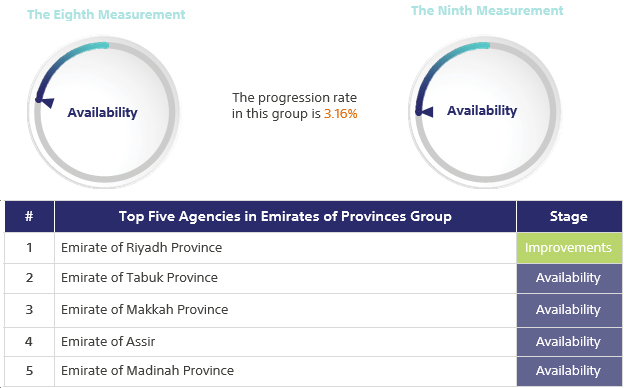
Governmental Agencies in Emirates of Provinces Group:
Emirate of Eastern Province
Emirate of Al Baha Province
Emirate of Al-Jowf Province
Emirate of Northern Borders Province
Emirate of Riyadh Province
Emirate of Qassim Province
Emirate of Madinah Province
Emirate of Tabuk Province
Emirate Of Jazan Province
Emirate of Hail Province
Emirate of Assir Province
Emirate of Makkah Province
Emirate of Najran Province
The Next Phase
In the next assessment cycle, the DGA shall develop the measurement tool to align with the new trend and best practices of digital government. The focus shall be on compliance with regulations related to digital transformation, measures aligned with the DGA framework, and approved policies and standards to achieve digital government outcomes at the national level.
For more details, click here to download the digital version
Suggestions and comments
For any inquiries or comments about the services or the current page, please fill in the required information.
Add Comment