





 Published 16/04/2024
1. Introduction
Based on Cabinet Resolution No. (418) dated 25/07/1442 AH, approving organization of Digital Government Authority (DGA), which stipulates in Articles (4/10/5) that “DGA shall be responsible for issuing measurements, indicators, tools, and reports to measure Government Agencies performances and capabilities in digital government, and the beneficiaries’ satisfaction thereof“, and providing support to Government Agencies with regard to digital government services, to adopt and enable modern technologies.
Proceeding from the role of DGA to effectively support Government Agencies and enable them to achieve their goals, and in order to meet “Digital Government Policy” content in terms of encouraging Government Agencies to adopt emerging technologies, which in turn accelerates the digital transformation process in various sectors, DGA has been working to assess ET adoption readiness, to help Government Agencies identify their current readiness levels, identify gaps and improvement opportunities, and present the necessary capacity building plans to successfully adopt emerging technologies in line with their respective needs, and ensure the strategic and sustainable realization of the desired benefits.
2. ET Adoption Readiness Assessment Summary
Emerging technologies are defined as technologies whose development and practical applications are still evolving (have not yet reached the full development stage) but are already spreading among users. They are characterized by their ability to significantly impact social and economic areas. Adopting such technologies leads to positive changes in the sectors and improves project performance in many respects. In this perspective, DGA has been keen on supporting and encouraging Government Agencies to adopt emerging technologies.
Digital Government’s ET Adoption Readiness Assessment is a periodic assessment carried out through a measurement methodology based on four core capabilities:
- Research.
- Communicate.
- Prove.
- Integrate.
for several Government Agencies that expressed interest in enrolling in the first session, with future sessions expected to include more Government Agencies. In general, this assessment can be used by the Agencies’ departments responsible for research and development, technical affairs, and innovation, as the assessment’s outcomes help them determine the current readiness levels to adopt emerging technologies, identify gaps, and plan the necessary steps to build capacity to successfully adopt emerging technologies and achieve the desired benefits.
The Assessment was announced on February 9, 2023, at the LEAP conference, and its first round is intended to assess Government Agencies’ readiness levels and enable them to adopt modern technologies.
2.1 ET Adoption Readiness Assessment Objectives
The ET Adoption Readiness Assessment is intended to achieve a number of important objectives, including:
- Contributing to achievement of the digital government strategic targets.
- Accelerating realization of the desired benefits of emerging technologies.
- Supporting Government Agencies in their journey towards ET adoption.
3. ET Adoption Readiness Assessment Methodology
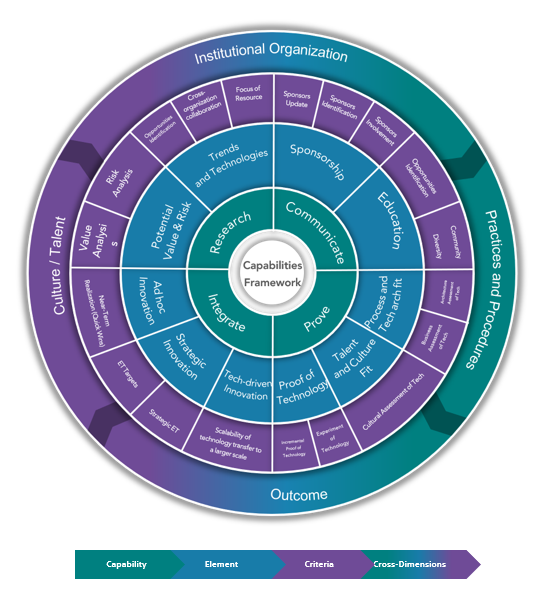
This figure shows the capability framework that was developed and designed to assess Government Agencies' readiness to adopt emerging technologies. The framework consists of four core capabilities (research, communicate, prove, and integrate) from which 10 elements are derived and assessed based on 19 criteria, with 4 cross-dimensions for each criterion.
3.1 The four main evaluated capabilities:
- Research: Due to the rapid rate of change in the technology field, it is essential to allocate resources to monitor technology’s new developments, whether in terms of beneficiaries, competitors, markets, or the technical capabilities of a particular technology trend. Researchers should work together across Government Agencies or build cooperation partnerships with external partners to capture these patterns, identify particular possibilities for each emerging technology, and then allocate each opportunity to either the short, the medium, or the long term.
- Communicate: Emerging Technology research cannot survive for long without clear lines of communication through which targets and outcomes of technology trend analysis are presented. It is necessary to direct the appropriate information towards the appropriate audience and to differentiate between general education in order to engage actors or stakeholders on one hand, and provision of specific information in order to stimulate funding and investment on the other hand.
- Prove: In order to express technological opportunities in a way that is persuasive to beneficiaries, it is necessary to prove the extent of ET adoption through proven practical experiences. With the aid of the “prove” capability, the Government Agency will determine each technology’s readiness to meet its requirements, but also whether or not the Agency is ready for the technology.
- Integrate: Innovations that are strategic in nature are those that pursue medium/long term emerging technology opportunities that align with the Agency’s broad objectives. This capability assesses how well the Agency is equipped to operationalize emerging technologies on large scales in a way that supports the strategic objectives while also being economical and practical in its implementation.
4. Classification Levels
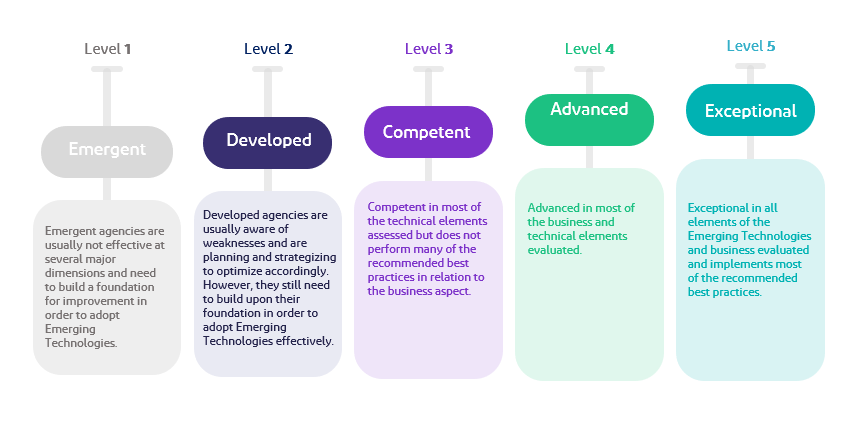
Government Agency readiness level is determined according to the outcome of the ET Adoption Readiness Assessment, based on capabilities and their sub-criteria in each measurement cycle in one of the following five levels:
5. Measurement Mechanism
Readiness assessment was conducted in the following three phases:
Phase One: Current State Assessment:
The current state at the Government Agency level is assessed against the four core capabilities using a detailed questionnaire with a series of capability-related questions. Government Agency representatives respond to the questionnaire and share relevant data.
Phase Two: Readiness Level Identification:
Readiness levels are determined by analyzing the data collected in phase one, processing inputs, and calculating points for each of the four capabilities. Accordingly, each Agency’s readiness progress level is identified across the five levels.
Phase Three: Recommendations and Action Plans for Improvement:
Recommendations and improvement action plans are presented, which include suggestions and recommendations for specific actions under each of the analyzed dimensions, to help the Agency progress through the five levels. In addition, the Agency may consider the ET Adoption Guideline to cover the various factors necessary to organize efforts and achieve desired outcomes while reducing the risks associated with the ET adoption journey.
For more information: Check the digital version.
Suggestions and comments
For any inquiries or comments about the services or the current page, please fill in the required information.
Add Comment