Saudi Arabia Flag
Official government website of the Government of the Kingdom of Saudi Arabia
How to verify Arrow Down
Link Icon
Links to official Saudi websites end withgov.sa

All links to official websites of government agencies in the Kingdom of Saudi Arabia end with .gov.sa

Password Icon
Government websites use the HTTPS protocol for encryption and security.

Secure websites in the Kingdom of Saudi Arabia use the HTTPS protocol for encryption.

Impact of Platforms Governance Regulations on the Government Expenditure Efficiency

Published 26/11/2025 Download File
Share This Page
Category
Regulatory studies
Document Number
DGA-2-1-02
Version Number
1.0
en محتوى المعرفة الرقمية
en المحتوى كاملا

1. Introduction

The Digital Government Authority (DGA) aims to keep pace with current and future requirements, contributing significantly to enhancing digital performance within government entities and improving the quality of services provided, in line with the Kingdom's ambitious Vision 2030 and with the strategic directions of DGA which emphasize the importance of providing an effective and flexible regulatory environment that adapts to future changes. 

AAs DGA is the competent authority for all matters related to Digital Government and the national reference for its affairs and based on its mandate to regulate digital government operations and achieve integration among all government entities, and as stipulated in Article 4 of its mandate, DGA is entrusted with "Regulating digital government operations, platforms, websites, and digital government services, and enforcing them to relevant entities" as well as "Optimizing the costs of digital government services", and reference to Circular No. 1/42/5589 issued on 7/11/1442 AH, requiring prior approval from DGA to establish or launch any platform, DGA developed this study on "Impact of Platforms Governance Regulations on the Government Expenditure Efficiency". 

This study aims to measure the impact of regulations issued by the Authority, which seek to evaluate both existing and new digital platforms. It concludes with an analysis of the role of these regulations in achieving the objectives of the “Integrated Government Program” launched by the Authority in July 2022, which aims to enhance government operational efficiency, unify the beneficiary experience, and play a critical role in optimizing government spending and identifying enablers to sustain its impact.

2. Study of Current State

2.1 General Framework of the Study: Existing Challenges

Prior to the issuance of digital platform governance regulations, government agencies in Saudi Arabia developed various digital platforms and services, This contributed to improving the efficiency of government services and enhancing the user experience, in addition to establishing a modern technological environment that accelerated the adoption of digital solutions and technological innovations. It also supported digital transformation and innovation, increased investment returns, and boosted the value of the national economy.

Statistics from the year 2022 show an increase in the number of government digital services and platforms.

On the other hand, the increase in digital services and platforms, along with the lack of coordination among government agencies, has led to the emergence of multiple challenges at various levels. These include duplication of digital platform content, redundancy in services and digital platforms, lack of consistency and integration in the user experience, and increased government spending, as detailed below.

  • Duplicate content on digital platforms: The availability of the content on more than one platform would cause duplication of the content with a high potential of contradiction.

  • Duplication of Digital Services and Platforms: Several websites and platforms that have same purpose or provide similar services may cause confusion to the beneficiary.

  • Inconsistent and Incoherent Experience: The existence of several difficulties for beneficiaries while accessing the service may reduce their satisfaction rate or prevent them to get the services the need.
  • High Government Expenditure: The increased spending on platforms and services with no clear direction to use shared resources, which may cause a waste of government resources that could have been avoided.

2.1 General Framework of the Study: Tasks of the Authority related to the subject of study 

In 2021, the Digital Government Authority was established pursuant to council of ministers Decision No. (418), dated 25/07/1442 AH.

Among the responsibilities assigned to it, as outlined in its mandate and relevant to the subject of this study, are:

  • Regulating digital government activities, platforms, websites, and government services, and standardizing them across government agencies.
  • Rationalizing the costs of digital government services.
     

2.1 General Framework of the Study: Strategic Directions of the Digital Government

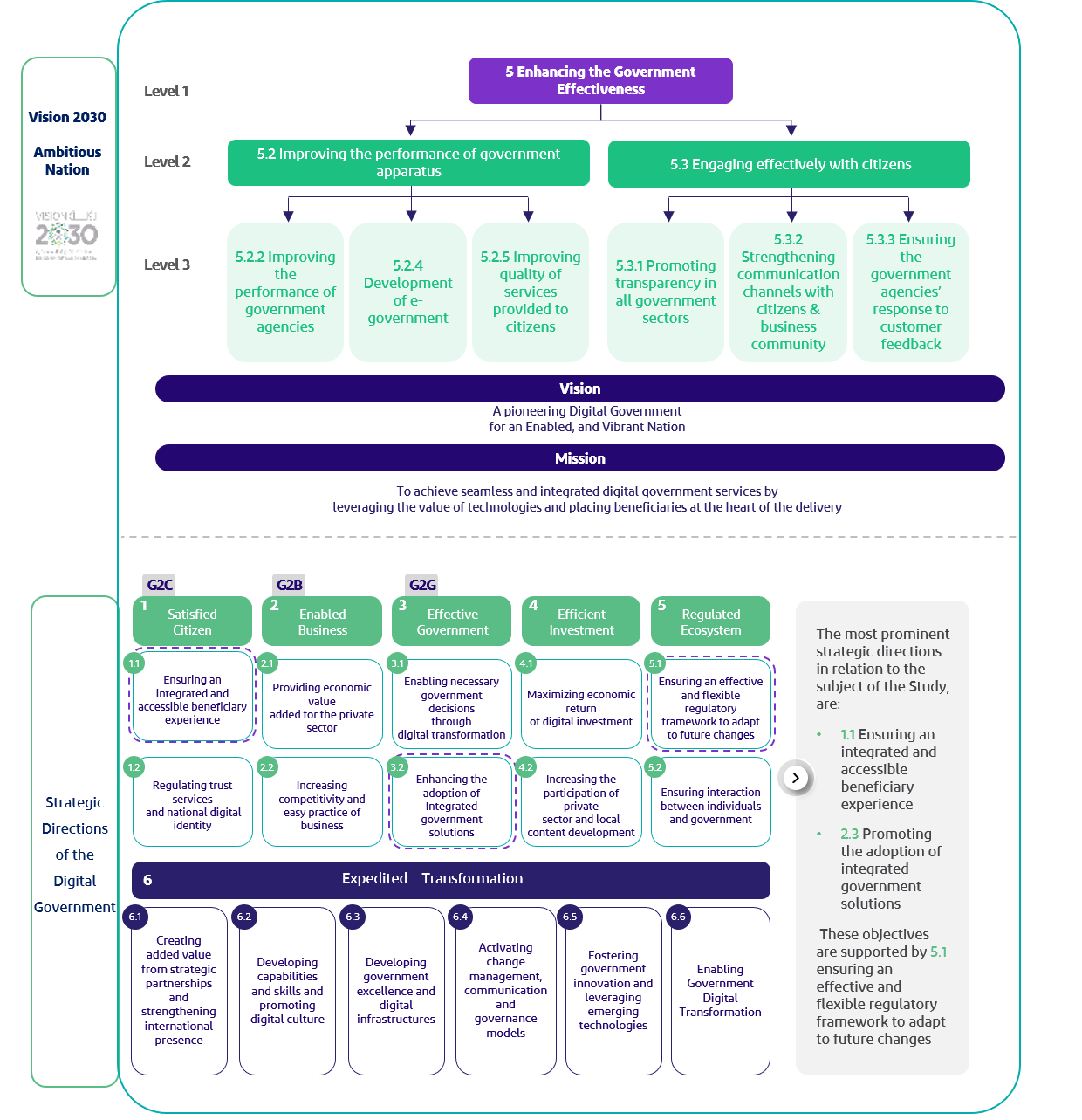
The Authority has adopted the strategic directions of the digital government, as illustrated in Figure 4, which supports the concept Whole-of-Government concept and governance of platforms.

Strategic Directions of the Digital Government
 

2.1 General Framework of the Study: Whole-of-Government concept Program and its Objectives

Towards implementing the strategic directions, the Authority launched the Whole-Of-Government Program in July 2022 to raise the efficiency of government work and to unify the beneficiary experience. The program represents an important step toward achieving the Kingdom’s Vision 2030 in digital transformation as it contributes to establishing a connected, efficient digital government with a unified and exceptional user experience. It is fundamentally based on launching unified national platforms and supporting data exchange among government agencies.

For 2025, the program aims to achieve 4 main objectives:

  1. Raising the percentage of unified interface designs  for digital platforms and websites to 80%.
  2. Raising the percentage of operational costs  (OpEX) through framework agreements to 70%.
  3. Raising the use percentage of the shared services for digital government products, portal to 75%.
  4. Reducing the number of government digital platforms and websites by 50%.


Elements of the Whole-Of- Government Program

  1. Unified Design System
  2. Activation of shared technological resources
  3. Platforms governance (Study Focus)
  • Integration of existing platforms
  • Governance of new platforms created

3. Benchmark

3.1 Benchmarked countries

The objective of the benchmark is to draw on the experiences and practices of successful and similar international entities in the field.

The following criteria were used to select the countries:

  • The country’s ranking in digital government (leading nations),

  • The country’s excellence in the specific subject of the study,

  • Relevance and applicability of the experience to the Kingdom,

  • Availability of key information sources through research or open data.

  • Based on these criteria, three leading countries with comparable and relevant experiences were selected for the benchmark analysis.


3.1 Benchmarked States: Benchmark dimensions

Four dimensions were identified for the Benchmark analysis.

  1. Motives and Objectives: Compared states' motives for launching Whole-Of-Government Programs include the platform governance aspect.

  2. Tools used: Tools that have been used to implement the plan to be completed, and enforce the governance of government platforms.

  3. Achieved impact: Results achieved through the announced initiative.

  4. Sustainability enablers: Enablers used by benchmarked states to sustain and enhance results


For more information, click on the link below:

Impact of Platforms Governance Regulations on the Government Expenditure Efficiency

suggestions

Suggestions and comments

For any inquiries or comments about the services or the current page, please fill in the required information.

Add Comment
Share your opinion and help us improve.
Share This Page
Last Update Date For Page Content : 02/02/2026 11:29 Saudi Arabia Time