Saudi Arabia Flag
Official government website of the Government of the Kingdom of Saudi Arabia
How to verify Arrow Down
Link Icon
Links to official Saudi websites end withgov.sa

All links to official websites of government agencies in the Kingdom of Saudi Arabia end with .gov.sa

Password Icon
Government websites use the HTTPS protocol for encryption and security.

Secure websites in the Kingdom of Saudi Arabia use the HTTPS protocol for encryption.

Retrieval-Augmented Generation & Enabling Enterprise Innovation

Published 07/01/2026 Download File
Share This Page
Category
Research Studies
Document Number
Version Number
1.0
en محتوى المعرفة الرقمية
en المحتوى كاملا

1. Introduction

Large language models (LLMs), such as OpenAI’s ChatGPT, Google Gemini, and Anthropic Claude, are driving new capabilities in AI across industries. But they have a core limitation: these models can only generate answers based on the data they were trained on. They cannot access the latest enterprise knowledge, confidential records, or internal policies without major retraining. This becomes a serious issue in situations where decisions depend on accurate and current information, for example, when responding to regulatory inquiries, checking for compliance with internal policies, or answering staff or citizen questions based on organization-specific data.

Enterprise Retrieval-Augmented Generation (RAG) addresses this problem by retrieving relevant content from internal enterprise resources, such as databases, policy documents, or knowledge repositories, at the time a question is asked. It then combines that information with the generative power of AI to produce fact-based, context-aware responses. This avoids the need to retrain the generative AI model, which is often costly and time-consuming. Importantly, RAG systems are designed with security in mind; enterprise data remains securely hosted on internal servers and is only accessed by the AI system when needed to generate a specific response.

For the public sector, the ability to deliver accurate, timely information is essential. Government agencies manage large volumes of data across laws, regulations, services, and citizen records. Enterprise RAG allows government systems to answer complex queries, assist with service navigation, and support staff with accurate internal information. This builds trust by ensuring that responses are both relevant and aligned with official sources. 

2. Definition of Retrieval-Augmented Generation (RAG)

Retrieval-Augmented Generation (RAG) is a method for enhancing the accuracy and usefulness of generative AI by connecting it to real-time, trusted information. According to Gartner, RAG offers a practical way to overcome one of the biggest limitations of large language models (LLMs). Tools such as ChatGPT, Google Gemini, and Mistral AI are trained on fixed datasets and cannot access private enterprise data or recent information unless they are retrained. This makes them less suitable for tasks that rely on up-to-date or organization-specific knowledge.

RAG solves this problem by retrieving relevant content from internal sources, such as databases or policy documents, at the moment a question is asked. It then uses that information to guide the AI’s response. This makes the answers more accurate, more relevant, and better aligned with the needs of the organization. RAG also avoids the need for expensive and time-consuming model retraining, while keeping sensitive data securely stored within the organization. 

Gartner provides a four-step model to explain how RAG systems operate:

  1. Rewriting the question: The system takes the user’s request and improves it so it can find the right information.

  2. Searching for answers: It looks through internal knowledge sources to find the most relevant content.

  3. Adding the information: The system combines the original request with the retrieved content to form a complete, well-informed prompt.

  4. Generating a response: The AI uses the combined prompt to produce a clear and accurate answer.

Core Components of RAG

  • Retrieval: RAG begins by identifying and extracting relevant information from internal sources such as policy documents, case files, or knowledge bases. This ensures that the AI system works with verified, current content specific to the organization.

  • Augmented: The retrieved content is then added to the user’s original query. This creates a richer prompt that gives the AI the context it needs to produce a meaningful and accurate response.

  • Generation: With the augmented prompt, the AI system generates a final response. The output reflects not just the model’s language capabilities, but also the organization’s internal knowledge and priorities. 

3. History of Enterprise RAG

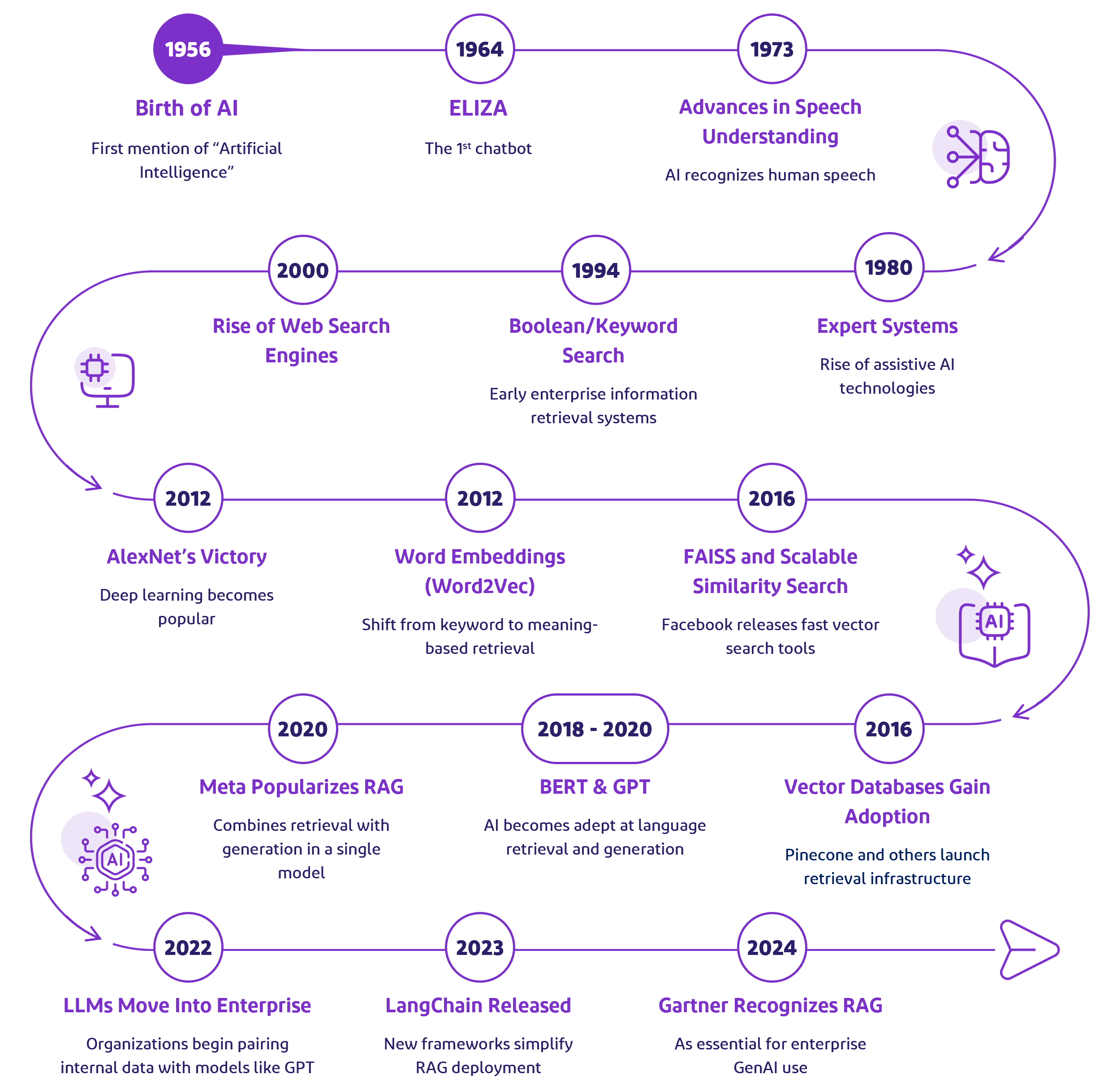
The history of Enterprise RAG reflects the long progression of technologies that made it possible to connect generative AI with real-time, organization-specific information. This timeline highlights key milestones, from early chatbots and expert systems to the rise of vector search, language models, and retrieval frameworks.


History of Enterprise RAG

The evolution of enterprise RAG reflects the convergence of information retrieval, natural language processing, and generative AI. Starting in 1956, foundational AI research laid the groundwork for computational reasoning, while ELIZA (1964) demonstrated the potential of conversational interfaces. By the 1970s, advances in speech understanding and the development of expert systems enabled machines to process structured data and support complex reasoning. In the 1990s, Boolean and keyword search matured in enterprise settings, giving rise to early information retrieval platforms. The explosion of web search in the 2000s marked a turning point, making large-scale access to digital information a public expectation.

The next major shift came with the introduction of word embeddings in 2012, enabling search systems to match meaning rather than just keywords. That same year, AlexNet’s success in computer vision signaled a broader leap in deep learning. In 2014, dense vector search methods emerged, soon followed by scalable tools like Facebook’s FAISS and the rise of vector databases such as Pinecone. These developments made it possible to retrieve relevant content with far greater accuracy and speed. Between 2018 and 2020, language models like BERT and GPT brought new fluency to AI systems, setting the stage for Meta’s 2020 release of the first popular retrieval-augmented generation architecture.

More recently, RAG has moved from theory to enterprise adoption. In 2022, organizations began pairing large language models with internal knowledge sources to deliver tailored, secure answers. The release of LangChain in 2023 simplified RAG implementation through reusable tools and frameworks. By 2024, Gartner identified RAG as a core capability for enterprise generative AI. Today, RAG is being deployed across government, healthcare, and regulatory systems, offering a scalable solution for delivering real-time, data-grounded intelligence while maintaining full control over sensitive content.

4. Significance of RAG

Retrieval-Augmented Generation (RAG) is reshaping how artificial intelligence engages with enterprise data, public systems, and global knowledge infrastructure. By combining retrieval with generation, RAG enables AI systems to deliver timely, accurate, and context-specific responses based on trusted information sources. This section explores the significance of RAG from three key perspectives: global, local, and public sector. Each view highlights how RAG is being adopted around the world, how it aligns with Saudi Arabia’s digital transformation strategy, and how it is enabling more grounded, secure, and reliable AI use across sectors.
 

For more information, click one of the links below:

Retrieval-Augmented Generation & Enabling Enterprise Innovation

Accessible version of the report for people with disabilities

suggestions

Suggestions and comments

For any inquiries or comments about the services or the current page, please fill in the required information.

Add Comment
Share your opinion and help us improve.
Share This Page
Last Update Date For Page Content : 04/02/2026 10:12 Saudi Arabia Time